
The 2026 capacitor market is moving toward higher energy density, tighter thermal control, and longer service life. Metallized Film Capacitors remain central to this shift. They appear in electric vehicles, solar inverters, wind converters, industrial drives, and fast-charging systems. Their thin polypropylene films, self-healing metallization, and low-loss construction support demanding electrical environments.
Professor Frede Blaabjerg, a widely recognized power-electronics authority, has emphasized, “Reliability must be designed, not assumed.” That principle strongly applies here. In 2026, leading types are expected to include polypropylene DC-link capacitors, AC-filter capacitors, snubber capacitors, pulse capacitors, and automotive-grade high-temperature designs. Each type answers a different engineering problem. DC-link units smooth voltage between switching stages. Snubber units reduce sharp transients near semiconductor switches. AC-filter models suppress ripple before it reaches the grid.
Physical details matter. A compact inverter may experience repeated thermal cycling, vibration, humidity, and high-frequency ripple. Poor heat dissipation can shorten capacitor life quickly. Metallized Film Capacitors can recover from small dielectric faults, but self-healing is not limitless. That detail is sometimes overlooked.
No universal ranking exists.
The “top” type depends on voltage, frequency, temperature, ripple current, enclosure space, and expected lifetime. Automotive systems may favor compact, vibration-resistant designs. Renewable-energy converters may prioritize high ripple capability and extended field life. Some 2026 predictions remain uncertain, because material costs and switching architectures can change quickly. This guide examines the strongest capacitor categories while recognizing those practical limitations.
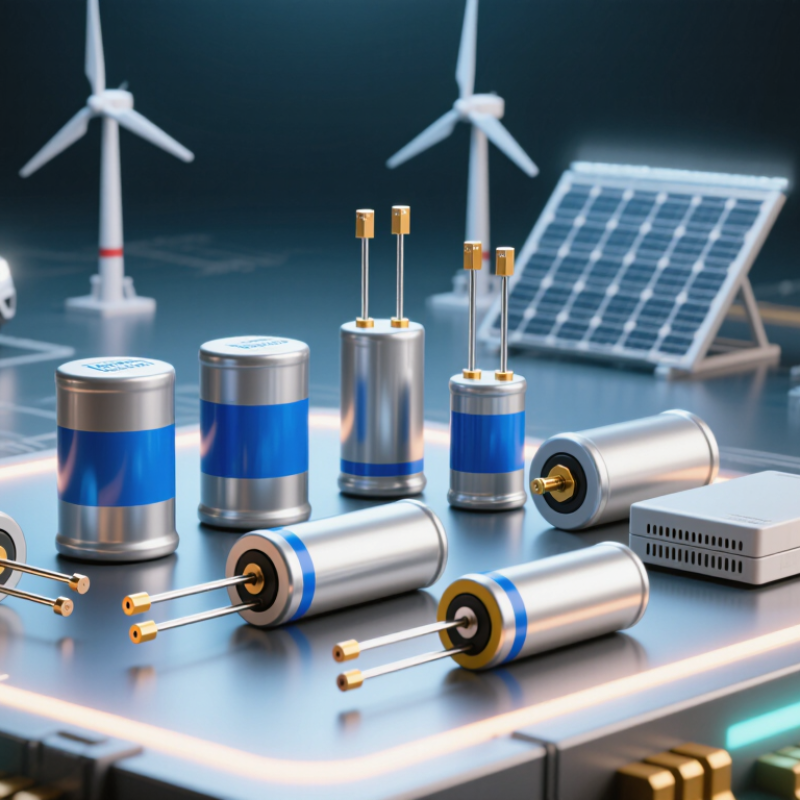
What Are the 2026 Top Types of Metallized Film Capacitors?
Metallized film capacitors use a thin plastic film and a microscopic metal coating. The coating forms the electrodes. Unlike foil designs, it can vaporize around a small puncture. This self-healing action limits damage, though it slightly reduces capacitance after repeated events. Metallized polypropylene remains popular for DC links, solar inverters, and industrial drives. Its low dielectric loss supports cooler operation at high ripple currents. Metallized polyester offers higher volumetric efficiency, but usually has greater losses and temperature sensitivity. The boundary is not always tidy.
A 2024 MarketsandMarkets industry report identifies power electronics, renewable energy, and electric mobility as major film-capacitor growth areas through 2029. These applications explain the strong position of polypropylene, especially in high-voltage DC filtering. Safety-rated X and Y capacitors also remain important in power-input suppression. They are designed for controlled failure behavior and defined insulation requirements. IEC 60384 standards provide the relevant qualification framework. In practice, engineers must still check humidity, pulse stress, vibration, and cooling. A catalog rating alone can mislead.
Tips: Match the dielectric to the waveform, not only the voltage. Measure ripple current at the real switching frequency. Leave voltage margin for transients. Check capacitance drift after self-healing events. I have seen compact prototypes pass bench tests, then overheat inside sealed enclosures. That failure is easy to underestimate. Consider film thickness, winding geometry, thermal paths, and end-spray quality together. Use manufacturer test data, independent laboratory results, and application measurements before final approval.

What Are the 2026 Top Types of Metallized Film Capacitors?
Metallized film capacitors are mainly classified by their dielectric material. Polypropylene, polyester, polyphenylene sulfide, polyethylene naphthalate, and polytetrafluoroethylene serve different electrical priorities. The dielectric controls loss, temperature stability, insulation resistance, and pulse behavior.
Metallized polypropylene capacitors offer very low dissipation factors and strong self-healing performance. They suit DC-link, resonant, and filtering circuits. Polyester capacitors provide higher volumetric efficiency and lower cost, but their temperature stability is weaker. PPS performs well in compact, high-temperature electronic assemblies. PEN occupies a practical middle position, while PTFE supports demanding thermal environments, although it is expensive and less common.
Industry estimates show why material selection matters. The MarketsandMarkets Film Capacitors Market report projected growth from about USD 2.7 billion in 2023 to USD 4.1 billion by 2028, representing an 8.7% CAGR. Grand View Research also identified renewable energy and electric vehicles as major demand areas, though market boundaries differ between reports. I would not treat one forecast as absolute.
Real design work is less tidy. A polypropylene part may outperform polyester in loss, yet require more board space. A PPS capacitor may tolerate heat better, but its cost can challenge volume production. IEC 60384-16 and IEC 60384-17 provide useful reference points for polypropylene film capacitors, but engineers still verify humidity, ripple current, voltage derating, and mechanical stress in the actual circuit. Small details matter.
The main metallized film capacitor types in 2026 are polypropylene, polyester, and polyphenylene sulfide designs. Each uses a thin metal layer deposited onto a plastic film. This structure supports compact construction and self-healing after minor dielectric breakdowns.
Metallized polypropylene capacitors remain important in inverters, solar power equipment, motor drives, and high-frequency filters. They offer low dielectric loss, stable capacitance, and strong pulse performance. Their weakness is larger physical size at the same capacitance rating.
Metallized polyester capacitors provide higher volumetric efficiency and lower cost. Engineers often select them for signal coupling, suppression, timing, and general power circuits. However, their temperature stability is usually less impressive.
Metallized PPS capacitors suit compact control boards and demanding automotive or industrial environments. They maintain useful electrical performance across wide temperature changes. Metallized paper capacitors still appear in selected safety and interference-control applications, especially where controlled failure behavior matters.
The choice is not always clean. A smaller capacitor may save board space but increase thermal stress. A higher voltage rating can improve reliability, yet it may raise cost and package size. During evaluation, engineers should check capacitance tolerance, ripple current, insulation resistance, humidity resistance, and expected operating temperature. Datasheet values alone can mislead when airflow is poor or switching frequency changes. A practical prototype test remains necessary.
Small details matter.
In 2026, metallized polypropylene capacitors remain strong choices for DC links, power conversion, and pulse applications. Metallized polyester types suit compact control circuits and moderate temperatures. AC motor capacitors and interference-suppression capacitors serve different electrical environments. Selection should begin with voltage, frequency, ripple current, and operating temperature.
Self-healing matters. When a tiny dielectric fault occurs, the metal layer around it vaporizes and isolates the defect. This can preserve operation, but it is not magic. Repeated faults gradually reduce capacitance and increase losses. Segmented metallization can limit damage more effectively, while thicker films usually improve voltage endurance. Safety also depends on construction. Pressure-disconnection features, flame-resistant cases, secure terminals, and suitable encapsulation reduce hazards during abnormal heating.
Tips: Check the capacitor’s tested safety class, not only its voltage rating. Confirm endurance data at the actual hot-spot temperature. Review ripple-current limits at the target frequency. Also inspect clearance, creepage, and mounting orientation. A smaller part may fit perfectly, yet perform poorly with restricted cooling. I have seen designs focus on capacitance while overlooking terminal heating. That mistake deserves a second review. Verify applicable IEC requirements and the manufacturer’s test conditions before approval.
In 2026, metallized polypropylene film capacitors remain common in high-power equipment. Their low loss and strong pulse performance suit DC-link circuits, solar inverters, wind converters, and motor drives. The IEA Global EV Outlook 2025 reports that electric car sales exceeded 17 million in 2024. That expansion increases demand for compact energy-storage and filtering components. Heat matters.
Metallized polyester capacitors are widely used in appliance controls, lighting systems, chargers, and general EMI suppression. They offer lower cost and smaller sizes than polypropylene types, although their losses can be higher. Metallized PEN capacitors fit tighter thermal spaces, including automotive control units and industrial sensors. For mains filtering, safety-rated metallized film capacitors are common in power supplies, HVAC equipment, and household electronics. Their application depends on certified insulation performance, not only capacitance.
Metallized polypropylene is also preferred for snubber networks, resonant converters, and AC output filters. In these locations, designers watch ripple current, dv/dt, humidity, and self-healing behavior. Mordor Intelligence’s 2025 film capacitor market assessment identifies automotive, renewable energy, and consumer electronics as major application clusters. A neat category chart can mislead. Real designs often compromise between size, temperature, lifetime, and price. Field testing still matters, especially when a capacitor operates beside a hot switching device.
| Metallized Film Capacitor Type | Primary Dielectric / Construction | Typical Characteristics | Common Voltage or Frequency Role | Where It Is Commonly Used |
|---|---|---|---|---|
| Metallized Polypropylene (PP) General-Purpose Type | A thin polypropylene film with vacuum-deposited metal electrodes; commonly available in self-healing designs. | Low dielectric loss, high insulation resistance, stable capacitance, and good resistance to moisture when properly packaged. | Low-loss DC or AC coupling, filtering, timing, and energy-transfer circuits. | Power supplies, industrial controls, lighting electronics, audio crossover networks, and general-purpose power conversion. |
| Metallized Polypropylene DC-Link Type | High-current polypropylene film construction, often using a low-inductance internal layout and heavy-duty terminals. | Very low equivalent series resistance and inductance, high ripple-current capability, long service life, and strong pulse handling. | DC-bus smoothing and energy buffering between rectifiers and switching inverters. | Variable-frequency drives, solar inverters, energy-storage converters, electric-vehicle power electronics, and industrial motor drives. |
| Metallized Polypropylene AC Filter Type | AC-rated metallized polypropylene film, frequently designed to meet applicable suppression or power-electronics safety requirements. | Low loss, good dielectric stability, self-healing behavior, and suitability for continuous AC operation when correctly rated. | Differential-mode filtering, power-factor correction networks, and AC line filtering. | EMI filters, industrial power supplies, renewable-energy inverters, motor controllers, and grid-connected converters. |
| Metallized Polypropylene Motor-Run Type | AC polypropylene film in a sealed or encapsulated housing intended for continuous connection across an AC motor circuit. | Designed for continuous AC duty, stable capacitance, low dissipation factor, and reliable operation over repeated motor cycles. | Phase shifting, auxiliary-winding support, and power-factor improvement in single-phase motors. | Fans, pumps, compressors, air-conditioning equipment, refrigeration systems, and household appliances. |
| Metallized Polypropylene Pulse and Snubber Type | High-strength polypropylene film with reinforced metallization, low-inductance leads, or construction optimized for repetitive pulses. | High dV/dt capability, low ESL, strong peak-current performance, and good resistance to repetitive switching stress. | Switching-transient suppression, commutation, resonant circuits, and pulse discharge. | IGBT and MOSFET snubbers, welding equipment, induction heaters, resonant converters, and high-power pulse circuits. |
| Metallized Polyester (PET) Type | Metallized polyethylene terephthalate film, usually selected where compact size and economical capacitance are important. | Higher dielectric constant and smaller volume than many PP designs, with good general-purpose electrical stability and cost efficiency. | Low- to medium-frequency DC filtering, coupling, bypassing, and signal applications. | Consumer electronics, control boards, LED drivers, instrumentation, telecom circuits, and compact power supplies. |
| Metallized Polyphenylene Sulfide (PPS) Type | High-temperature PPS film with metallized electrodes and highly stable dimensional and dielectric properties. | Excellent temperature stability, low moisture absorption, low dielectric loss, and strong long-term capacitance stability. | High-frequency filtering, precision timing, snubber networks, and compact circuits exposed to elevated temperatures. | Automotive electronics, engine-control systems, industrial sensors, high-temperature power modules, and precision instrumentation. |
| Metallized Polyphenylene Naphthalate (PEN) Type | Metallized PEN film offering a balance between the cost of PET and the temperature performance of higher-grade film dielectrics. | Better thermal stability than standard PET, good mechanical strength, and useful resistance to humidity and soldering heat. | General-purpose filtering, decoupling, timing, and moderately demanding automotive or industrial circuits. | Automotive control units, industrial automation, power supplies, lighting equipment, and communication hardware. |
| Metallized Paper-Film Type | Cellulose paper dielectric with metallized electrodes, commonly impregnated or encapsulated to improve insulation and environmental resistance. | Good pulse-energy capability and self-healing behavior, but generally larger and more moisture-sensitive than modern plastic-film alternatives. | AC filtering, pulse discharge, high-voltage energy storage, and applications requiring robust discharge performance. | Legacy and specialized power electronics, high-voltage equipment, industrial compensation systems, and selected interference-suppression applications. |
Note: Actual suitability depends on rated voltage, capacitance, temperature class, permissible ripple current, dV/dt, insulation requirements, safety classification, package design, and the applicable product standard.
3295 Cobb International Blvd.
Kennesaw, GA 30152
800-367-1377
sale@patiostools.com
© 2023 - Marsh Instruments