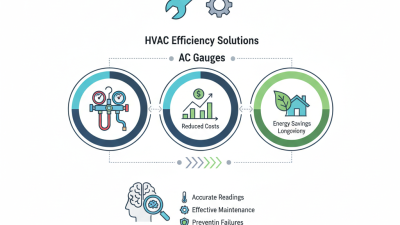
Choosing the right ac gauges is not a cosmetic decision. It affects charging accuracy, compressor protection, service time, and refrigerant loss.
The International Energy Agency reports that global space-cooling demand could triple by 2050 without stronger efficiency measures. The United Nations Environment Programme also links better servicing practices with lower refrigerant emissions. These findings make measurement discipline more important, not less. A steady needle, clean hoses, and a calibrated sensor can change the diagnosis. Small details matter.
HVACR educator Jim Bergmann, founder of MeasureQuick, offers a practical field principle: “Test the system before you trust the gauge.” That idea guides this review. We compare ten ac gauges by pressure resolution, temperature measurement, accuracy, durability, refrigerant compatibility, and digital usability. Some models excel on a busy rooftop. Others feel better in a residential service van. None is perfect.
It is easy to overvalue a bright screen.
A gauge cannot repair a leak, replace airflow testing, or correct a restricted filter. The U.S. Environmental Protection Agency’s Section 608 guidance reinforces the need for proper recovery, handling, and service procedures. NIST measurement guidance also reminds technicians that every reading carries uncertainty. This list therefore considers real working conditions, not only advertised specifications. We examine response speed, hose quality, battery behavior, and readability under direct sunlight. The results may challenge a few familiar names. They may also expose weaknesses in our own testing assumptions. That is useful. Reliable charging begins with honest measurement.
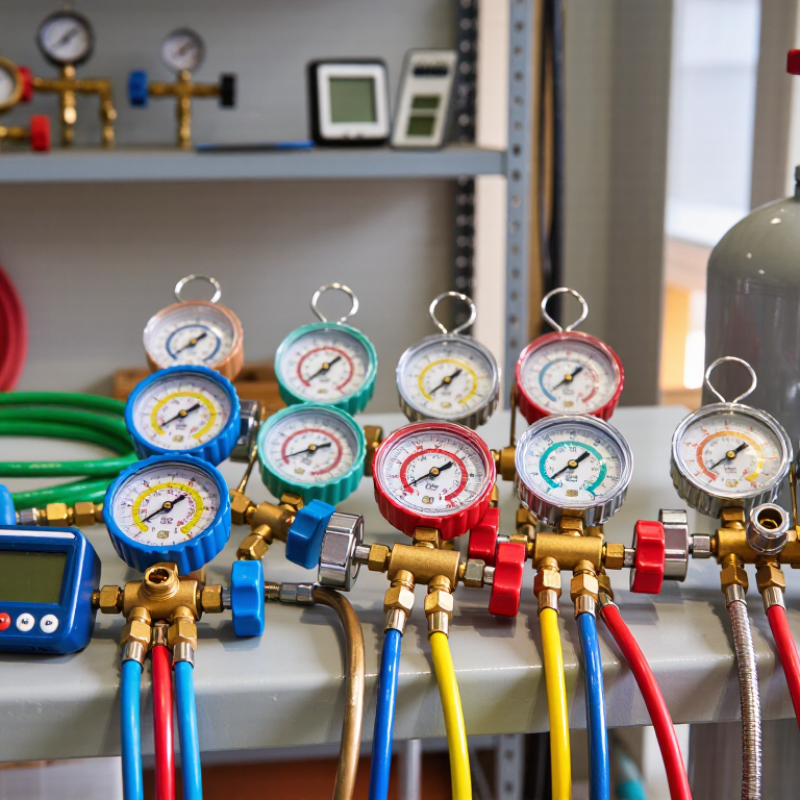
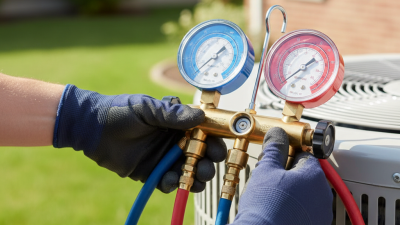
AC gauges are working instruments, not simple pressure displays. A manifold gauge set connects the system’s low- and high-pressure sides, helping technicians observe refrigerant behavior during service. The readings can reveal undercharging, overcharging, restrictions, or unusual compressor performance. However, pressure alone does not confirm the correct charge. Outdoor temperature, indoor airflow, refrigerant type, and system design all affect the result.
Accuracy begins with clean hoses, tight connections, and properly zeroed gauges. A technician should verify the refrigerant label and follow the equipment manufacturer’s charging method. Superheat measurements are useful for many fixed-orifice systems, while subcooling often guides charging in systems with expansion devices. Digital temperature clamps can improve these calculations, but poor contact creates misleading numbers. Small details matter.
In the field, a stable reading may take several minutes after adding refrigerant. A cold suction line can look reassuring while airflow remains restricted. That mistake is easy to make. I would also question any gauge that has suffered a fall, shows a bent needle, or has damaged seals. Calibration is not permanent, and visual confidence can be wrong. Safe recovery, controlled charging, and accurate pressure-temperature references protect both the equipment and the person servicing it.
Accurate refrigerant charging begins with the gauge, not the cylinder. A dependable AC gauge should measure pressure precisely across the system’s working range. It should also show temperature clearly, because technicians compare pressure with saturation temperature.
The U.S. Department of Energy’s Building America research reports that incorrect refrigerant charge can reduce cooling efficiency by roughly 5% to 20% in field conditions. Small errors matter.
Look for low measurement uncertainty, stable sensors, and clear resolution. A gauge that drifts after sitting in a hot service van can mislead even an experienced technician. Digital models should record pressure and temperature together, while analog models need smooth movement and easy calibration checks.
ASHRAE Standard 41.1-2020 emphasizes documented measurement methods and uncertainty, which supports choosing instruments with stated accuracy rather than vague “professional” labels. That detail is often overlooked.
Durable hoses, secure valves, and low-loss connections improve practical accuracy. A poorly sealed fitting may create a false pressure reading before charging even begins. Data logging is useful when verifying superheat, subcooling, and system performance over time.
Still, more screens do not guarantee better work. I have seen technicians trust an attractive display while ignoring airflow, outdoor temperature, or a restricted filter. The U.S. EPA’s refrigerant management guidance also reinforces careful recovery and leak prevention during service.
Check calibration regularly. No gauge stays perfect.
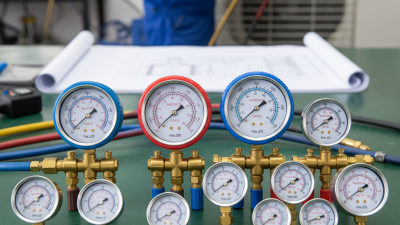
The ten best AC gauges differ mainly in accuracy, durability, and working style. A traditional two-valve manifold remains useful for basic charging and pressure checks. Its mechanical readings are easy to understand, even in bright sunlight. A four-valve manifold adds faster evacuation and recovery control. It suits technicians handling larger systems or frequent service calls. Simple still matters.
Digital gauges provide pressure readings, temperature calculations, and superheat or subcooling estimates. They perform well when the technician enters the correct refrigerant and temperature data. Wireless models reduce hose movement around tight equipment spaces. However, weak batteries can interrupt a job at an inconvenient moment. Readings can drift. A calibrated sensor is more valuable than a crowded screen.
The remaining leading choices serve specific conditions. Compact gauges fit residential units and short inspections. Heavy-duty analog sets tolerate rough transport and repeated field use. Vacuum-capable gauges help confirm evacuation quality, while temperature-clamp sets improve charging decisions near the suction and liquid lines. Gauges with backlit displays support work in basements or shaded outdoor units. I prefer clear valves and sturdy hose connections over extra software features. That preference may not suit every technician. Before charging, compare pressure readings with measured line temperatures, system specifications, and ambient conditions. A gauge can report precise numbers while the diagnosis remains wrong. Personally, I would recheck an unusual reading rather than trust the first result.
Comparison of ten common AC gauge configurations using representative pressure-accuracy specifications. Lower values indicate smaller measurement error and more precise refrigerant charging.
Digital manifold gauges generally provide the lowest pressure error, while analog gauges remain practical for basic servicing because they are durable, simple to read, and do not require batteries. Actual performance varies with calibration, temperature, hose condition, and refrigerant type.
Choosing the right AC gauge depends on the HVAC system, refrigerant, and service task. A basic manifold gauge may suit a residential split system with familiar refrigerant pressures. Heat pumps require gauges that read both cooling and heating pressures clearly. Mini-split systems often need smaller hoses and fittings because their service ports are compact. Commercial equipment may require a wider pressure range and stronger construction.
Match the gauge scale to the refrigerant listed on the unit. Pressure readings differ greatly between refrigerants, even at similar temperatures. A digital gauge can calculate saturation temperature quickly, while an analog gauge remains useful in bright outdoor conditions. Accuracy matters, but calibration matters more. A precise-looking screen can still be wrong. Check the tool against known readings when possible, and inspect hoses for trapped air or damaged seals. Never charge by pressure alone; compare pressure, temperature, airflow, and the system’s specified charging method.
Tips: Use low-loss fittings to reduce refrigerant release during connection. Keep separate hoses for different refrigerants when practical. For systems with unfamiliar refrigerants, confirm the pressure-temperature chart before opening a valve. I still recheck superheat and subcooling after charging, because one stable reading can hide poor airflow. That extra check takes minutes. It can prevent a costly mistake.
Accurate refrigerant charging begins with the right gauges and a controlled method. Choose a manifold rated for the refrigerant, pressure range, and system temperature. Inspect hoses, seals, valves, and connectors before connecting anything. Small damage can create a misleading reading or a sudden leak.
Wear eye protection and insulated gloves. Work in a ventilated area. Follow local regulations and the equipment service instructions. Connect the high- and low-side hoses carefully, keeping the system isolated until readings are needed. Record outdoor temperature, indoor temperature, suction pressure, and discharge pressure. Pressure alone is not enough. Compare readings with the manufacturer’s target superheat or subcooling values. A digital probe can improve temperature accuracy, but it still needs proper placement.
Use a calibrated recovery and charging scale. Add refrigerant by the specified mass, not by guesswork or cylinder pressure. Charge through the correct service port and monitor the scale continuously. Never mix refrigerants or intentionally release refrigerant into the atmosphere. After charging, check for leaks and confirm stable operation under normal load. Listen for unusual compressor sounds and watch for frost in unexpected locations.
I have seen gauges appear normal when a restricted filter, poor airflow, or a weak connection caused the real problem. Recheck the setup before adjusting charge. A second measurement may prevent an expensive mistake.
3295 Cobb International Blvd.
Kennesaw, GA 30152
800-367-1377
sale@patiostools.com
© 2023 - Marsh Instruments