Best Measuring Devices for Accurate Measurements in Various Fields
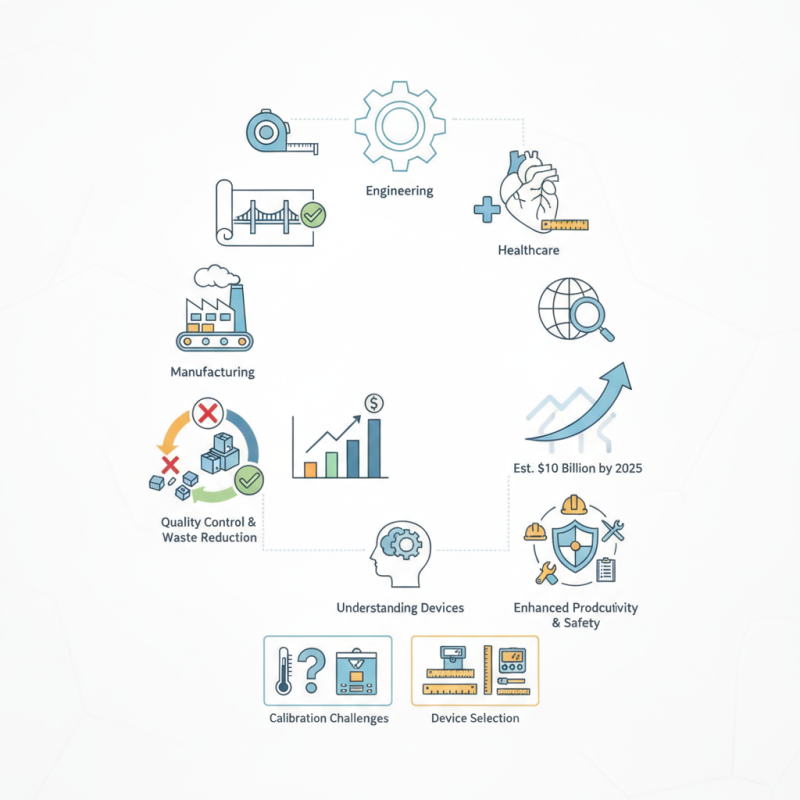
Accurate measurements are critical across various fields, from construction to healthcare. In engineering, precise dimensions ensure structural integrity. The National Institute of Standards and Technology (NIST) emphasizes the need for high-quality measuring devices to enhance safety and efficiency. The global market for measuring devices is projected to reach $10 billion by 2025, reflecting their essential role.
In manufacturing, errors in measurement can lead to significant financial losses. A study by the International Organization for Standardization (ISO) revealed that poor quality measurements can account for up to 20% of operational costs in production lines. This highlights the necessity of reliable measuring devices in maintaining quality control and minimizing waste.
Despite advancements, inconsistencies still arise. Users may face challenges in calibration and device selection. Understanding the features of various measuring devices is crucial. With the right tools, professionals can achieve more accurate results, ultimately enhancing productivity and safety in their respective fields.
Best Measuring Devices for Accurate Measurements in Various Fields
When it comes to precise measurements, the right tools make all the difference. In construction, for instance, laser distance meters provide quick and accurate measurements. These devices can measure distances of up to several hundred meters, allowing for efficient planning and execution of projects. A simple miscalculation can lead to costly repairs, making accurate measurements crucial.
In the field of science, digital calipers play a vital role. These devices measure internal and external dimensions with impressive accuracy. Many professionals rely on calipers for tasks that require precise specifications. However, not all calipers are user-friendly. Some models can be challenging to calibrate, leading to errors. It is essential to choose devices that are both reliable and easy to operate.
In the electrical field, multimeters are indispensable. They can measure voltage, current, and resistance, which are critical for diagnosing electrical issues. However, users often overlook the importance of periodic calibration. Without proper calibration, readings can become skewed, resulting in potential risks. Even seasoned electricians need to stay vigilant and ensure their devices remain reliable.
Best Measuring Devices for Accurate Measurements in Various Fields
| Device Type |
Measurement Type |
Accuracy |
Field of Use |
| Digital Caliper |
Length |
±0.02 mm |
Manufacturing, Engineering |
| Laser Distance Meter |
Distance |
±1.5 mm |
Construction, Real Estate |
| Pressure Gauge |
Pressure |
±0.5% |
Manufacturing, HVAC |
| Multimeter |
Voltage, Current, Resistance |
±0.5% |
Electrical Engineering |
| pH Meter |
pH Level |
±0.01 pH |
Laboratory, Agriculture |
Types of Measuring Devices and Their Applications
When it comes to accurate measurements, various measuring devices play a crucial role across industries. In construction, laser distance meters have revolutionized how measurements are taken. A report by MarketsandMarkets indicates that the laser measuring device market is expected to reach $1.2 billion by 2025. This increase highlights the shift towards precision tools that reduce human error. These devices can measure distances up to 500 meters with an accuracy of ±1.0 mm, making them essential for architects and builders.
In the field of healthcare, digital calipers allow for precise measurements of body parts, enhancing patient diagnostics. According to the Journal of Medical Devices, accurate assessments can lead to better treatment plans. Devices like these can measure with an accuracy of 0.01 mm, showing the importance of precision in medical settings. However, the reliance on technology also introduces potential for miscalibrations, requiring regular checks.
In laboratories, analytical balances are vital for weighing samples. Their accuracy can be up to 0.0001 grams, crucial for chemical experiments. Nonetheless, factors like air currents and vibration can affect their precision. Continuous calibration and environmental control are necessary to ensure reliability. These examples illustrate how measuring devices impact diverse fields, driving the need for ongoing assessment and improvement in measurement accuracy.
Precision in Measurement: Importance and Standards
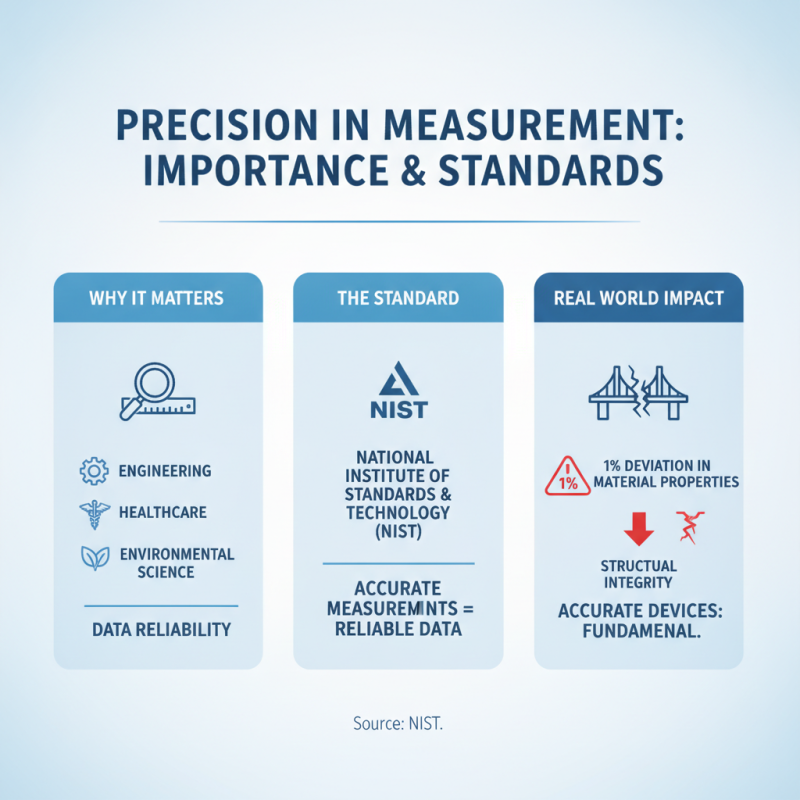
Precision in measurement plays a crucial role in various fields, including engineering, healthcare, and environmental science. According to the National Institute of Standards and Technology (NIST), accurate measurements underpin the reliability of data across industries. For example, a minor deviation of just 1% in measuring material properties can result in significant impacts on structural integrity in construction. Accurate devices are not just optional; they are fundamental.
In healthcare, improper measurements can lead to incorrect dosages or misdiagnoses. The World Health Organization states that 50% of medical errors are due to measurement inaccuracies. Emphasis on tools that adhere to strict standards ensures that healthcare professionals can provide effective patient care. It’s essential to remember that precision can vary based on the device and its calibration.
Environmental monitoring also relies heavily on precise measurements. Instruments measuring air and water quality must meet established standards to ensure public safety. Failures in these measurements can result in hazardous conditions. The need for continual improvement in these devices highlights the ongoing challenge industries face. Regular audits and recalibration are necessary to maintain accuracy and uphold safety standards.
How to Choose the Right Measuring Device for Your Needs
Choosing the right measuring device is crucial in various fields. Accuracy is paramount, whether in construction, healthcare, or scientific research. A recent survey by the National Institute of Standards and Technology indicates that 70% of measurement errors arise from using inadequate tools. Therefore, selecting the right device can significantly affect outcomes.
When considering a measuring device, assess its precision and application. For instance, digital calipers offer high precision for mechanical parts, while ultrasonic sensors excel in distance measurements. According to the American Society for Quality, 80% of professionals prioritize measurement accuracy over cost. This reflects the need to balance quality with budget constraints.
Reflection is essential when evaluating measuring devices. Understanding your specific needs is vital. Some devices may have functions that seem beneficial but are complicated to use. Regularly reviewing your tools can lead to better choices in the long run. Adapting to technological advances might lead you to discover devices that are more efficient but require a learning curve.
Best Measuring Devices for Accurate Measurements in Various Fields
This chart displays the average accuracy of various measuring devices used in different fields, highlighting the importance of choosing the right tool for precise measurements.
Emerging Technologies in Measurement Devices
Emerging technologies have revolutionized the landscape of measurement devices, enhancing accuracy across various fields. Laser measurement tools are now commonplace. They provide rapid and precise measurements, often replacing traditional tape measures. These devices use light to gauge distances, ensuring high reliability. Additionally, 3D scanning technologies create digital models of physical objects. This accuracy is crucial in construction and engineering for project planning.
Tips: When using laser measurements, ensure that the device is calibrated regularly. A small error can lead to significant discrepancies in larger projects. For 3D scanning, understand the impact of environmental factors like lighting and surface textures. Poor conditions can yield unreliable data.
The integration of IoT in measurement devices is also noteworthy. Smart sensors can transmit data in real-time. This connectivity allows for monitoring and analysis on-the-go, leading to improved productivity. However, users must be cautious about data privacy and security. Mismanagement of sensitive information can have severe consequences.
As these technologies advance, selecting the right device becomes challenging. It’s essential to assess the specific needs of your field. Unreliable devices or inadequate understanding can hinder progress. Choose wisely and stay informed to maximize measurement accuracy.
Conclusion
In the realm of precise measurements, selecting the right measuring devices is crucial across various fields. This article explores the different types of measuring devices, emphasizing their applications in industries such as construction, healthcare, and science. It discusses the significance of accuracy in measurements and the established standards that guide users in achieving precision.
When choosing measuring devices, factors such as the specific requirements of the task and the environment play a vital role. The article also highlights emerging technologies that are revolutionizing measurement capabilities, making them more efficient and reliable. Lastly, it underscores best practices for maintaining the accuracy of measuring tools, ensuring they perform optimally for accurate results. Overall, understanding and utilizing the appropriate measuring devices can significantly enhance the effectiveness and reliability of data collection in any field.