How to Choose the Right Low Pressure Gauges for Your Needs?
Choosing the right low pressure gauges can be a daunting task. There are many options available in the market. Without proper guidance, anyone may feel overwhelmed.
Low pressure gauges are essential for various applications. They help monitor pressure levels accurately. However, selecting the wrong gauge can lead to serious errors. For instance, using a gauge not suited for your specific needs can result in malfunction.
Consider the environment where the gauge will be used. Are temperatures fluctuating? Is moisture present? These factors influence performance. It's crucial to think about durability and accuracy as well. You might realize that some gauges do not meet your expectations. Reflecting on these aspects will help you make a better choice. Fine-tuning your selection process leads to improved results.
Understanding Low Pressure Gauges: Types and Applications
Low pressure gauges are essential in various industries, including HVAC, food processing, and pharmaceuticals. These instruments measure pressures typically below 15 psi. Understanding their types and applications can significantly enhance equipment efficiency.
There are several types of low pressure gauges. Bourdon tube gauges are common due to their reliability and accuracy. These gauges work by bending a curved tube under pressure. Electronic gauges offer digital readings, which can be more user-friendly. They have become popular in industries demanding precise measurements. According to a market report, over 50% of low pressure gauges sold in 2022 were electronic, reflecting a shift toward digital solutions.
It's crucial to consider the specific application when choosing a gauge. For instance, a food processing facility requires a gauge that withstands high sanitation standards. In contrast, a laboratory might prioritize precision and response time. Sometimes, users underestimate the impact of ambient conditions on gauge performance. Factors like temperature fluctuations and vibrations can affect readings. Realizing these nuances is vital for effective equipment operation and maintenance.
Key Factors to Consider When Selecting Low Pressure Gauges
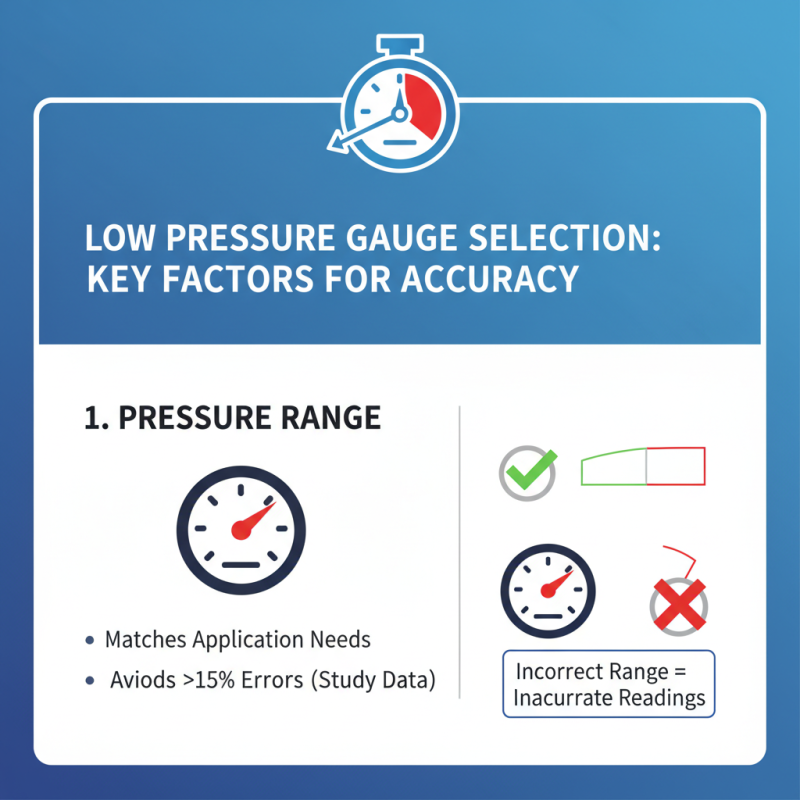
When selecting low pressure gauges, key factors play a crucial role in ensuring accuracy and reliability. One main consideration is the pressure range. Accurate measurement depends on choosing a gauge that matches your specific application. A study shows that gauges operating outside their optimal range can lead to significant errors, sometimes exceeding 15%. Understanding the application’s required range is vital to avoid these pitfalls.
Another important factor is the gauge type. Digital vs. analog displays can influence user experience and data interpretation. A report by the Engineering Industry Association indicates that 70% of professionals prefer digital gauges for their clarity and ease of use. However, analog gauges can still offer advantages in certain environments. It’s essential to evaluate your needs carefully.
Material compatibility is also key. Gauges must resist pressure and environmental factors. For example, corrosive or high-temperature environments demand specific materials. Failure to consider materials might lead to premature wear or even gauge failure, thus affecting measurement accuracy. In fact, data suggests that nearly 30% of gauge failures stem from material incompatibility. Consider your unique conditions to make the right choice.
Assessing Accuracy and Range in Low Pressure Gauge Choices
When selecting a low pressure gauge, accuracy and range are critical factors to consider. A report from the Pressure Instruments Association found that 70% of measurement errors arise from improper gauge selection. This highlights the importance of choosing a gauge that fits your specific requirements.
Accuracy is typically expressed as a percentage of full scale. For instance, a gauge with a 1% accuracy range will deviate at most 1% from the actual pressure. This means that, for a gauge rated at 100 psi, the reading could vary by ±1 psi. Knowing this variance helps ensure your measurements will be reliable for sensitive applications.
Range is another crucial aspect. The gauge should cover the operational range of your system without being overly broad. A widely cited industry standard suggests that the gauge's range should be 1.5 to 3 times the maximum pressure expected in use. This promotes longevity and minimizes wear. However, using a gauge with an excessively high range can also lead to imprecise readings, which some may overlook. This invites reflection on the balance between versatility and specificity in gauge selection.
How to Choose the Right Low Pressure Gauges for Your Needs?
| Gauge Type |
Measurement Range |
Accuracy |
Material |
Connection Type |
| Bourdon Tube Gauge |
0-15 PSI |
±2% |
Brass |
1/4" NPT |
| Diaphragm Gauge |
0-30 PSI |
±1% |
Stainless Steel |
1/4" NPT |
| Digital Gauge |
0-10 PSI |
±0.5% |
Plastic |
Battery Operated |
| Capsule Gauge |
0-5 PSI |
±3% |
Aluminum |
1/8" NPT |
Material Compatibility: Ensuring Gauge Durability and Functionality
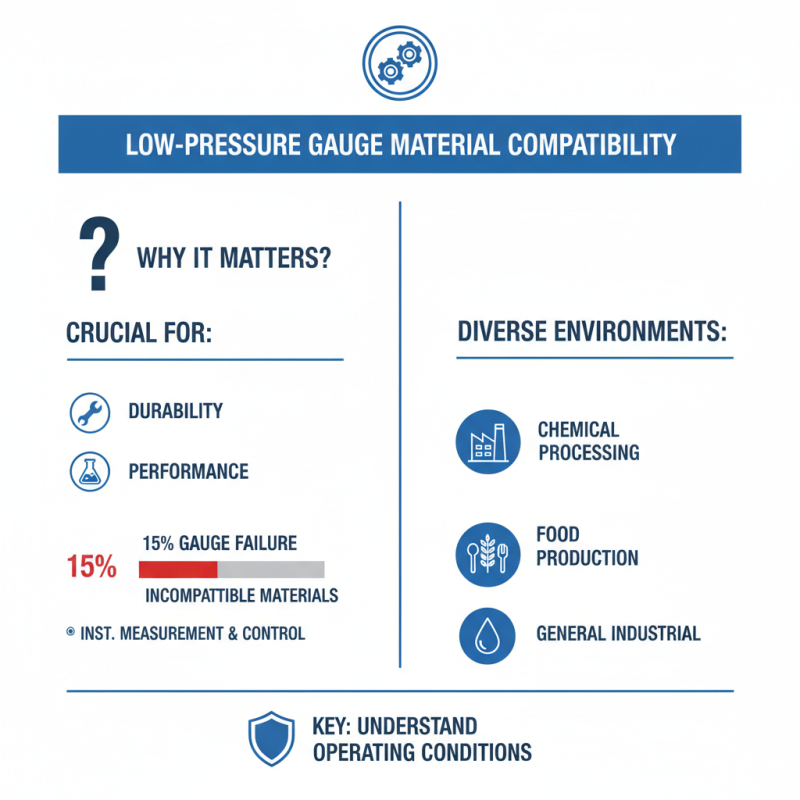
When selecting low pressure gauges, material compatibility is crucial for durability and performance. Many industries use gauges in diverse environments, from chemical processing to food production. For instance, a report by the Institute of Measurement and Control indicates that inappropriate material choice can lead to gauge failure in 15% of cases. Therefore, understanding the specific conditions in which the gauge will operate is vital.
Consider the materials exposed to the fluid or gas. Metal gauges, for example, can corrode when exposed to certain chemicals. Similarly, plastic gauges may not withstand high temperatures. A study by the American Society of Mechanical Engineers found that 20% of gauge failures are due to such material incompatibility. This highlights the importance of proper selection. A common oversight is underestimating environmental factors, such as humidity or pressure fluctuations.
Improper material choice can cause inaccuracies and safety hazards. It’s essential to consider both the application and the materials’ properties. Regular maintenance can mitigate some issues, but an initial wrong choice can lead to significant costs. Users should reflect on their specific needs before making a decision, as the implications of choosing unsuitable materials can be costly.
Maintenance Tips to Extend the Life of Low Pressure Gauges
Proper maintenance is crucial for extending the life of low pressure gauges. Regular calibration is vital. Studies show that uncalibrated gauges can lead to 10% measurement error. This can compromise safety and efficiency in industrial processes. Check for signs of wear or damage often. If gauges are exposed to extreme temperatures, performance may decline rapidly.
Cleaning is another essential step. Dust or moisture can affect accuracy. Use a soft brush or cloth for regular cleaning. In more polluted environments, monthly cleaning might be necessary. Neglecting this can lead to unreliable readings. Regularly inspect the connections for leaks. A simple leak can cause a significant drop in performance and accuracy.
Storage matters too. If not in use, store gauges in a dry, stable environment. However, many operators fail to recognize this. Utilizing protective cases can also minimize the risk of damage. Reports suggest that improper storage can reduce lifespan by up to 30%. Reflect on the ways you maintain your equipment. A small change can make a big difference.