How to Choose Liquid Filled Pressure Gauges?
Choosing liquid filled pressure gauges starts with understanding what the instrument will face in daily service. These gauges use liquid inside the case to damp pointer movement caused by vibration and pressure pulsation. The result is often easier to read, especially near pumps, compressors, and mobile equipment. Less pointer flutter can also reduce wear on moving parts. But a filled case does not make every gauge suitable for every job.
Begin with the operating pressure. A gauge should have a range that keeps normal readings away from the scale’s extremes, while still allowing for expected pressure peaks. Check the process medium, wetted materials, and connection type; compatibility matters at the point where pressure enters the instrument. Then consider ambient temperature, vibration, mounting position, and the required accuracy. Small details matter. A poorly chosen fill fluid may behave differently in extreme temperatures, and a convenient connection may not fit the installation.
There is no universal best choice. A workshop gauge may need different protection from one mounted outdoors or beside a vibrating pump. Confirm the manufacturer’s specifications, including pressure range, accuracy class, temperature limits, and case material. Also ask whether the liquid fill suits the operating environment. That detail is easy to overlook. A careful selection balances readable measurements, material compatibility, service conditions, and maintenance needs. These checks help narrow the options before comparing models, and they make the final choice easier to justify.
Understand How Liquid-Filled Pressure Gauges Work
How to Choose Liquid Filled Pressure Gauges?
Understand How Liquid-Filled Pressure Gauges Work
A liquid-filled pressure gauge has a sealed case containing a damping fluid, commonly glycerin or silicone. The fluid surrounds the pointer mechanism and reduces rapid movement caused by vibration or pulsating pressure. Inside, pressure enters a sensing element, often a curved Bourdon tube. As the tube flexes, a linkage transfers that movement to the pointer and dial. The case fluid does not normally touch the process pressure.
That damping makes readings easier to follow on a vibrating pump line. It can also help protect moving parts from wear. A steady pointer is useful, but it does not guarantee an accurate reading. The gauge still needs a suitable pressure range, connection, and accuracy class. Check the process temperature, too. Heat can change the fill fluid’s behavior, while cold conditions may slow the pointer.
The fill fluid matters. Glycerin is common for general use; silicone may suit wider temperature conditions, depending on the gauge design. Don’t assume every filled gauge fits every environment. A liquid-filled case may be less suitable where fluid leakage, chemical compatibility, or extreme temperatures are concerns. There is a small trade-off here: damping calms the pointer, yet it can make quick pressure changes less obvious. Consider how the gauge will be read and serviced, not just how it looks on a specification sheet.
Determine the Required Pressure Range and Accuracy
Choose a pressure range that keeps normal readings near the middle of the dial, with expected peaks comfortably below full scale. A 0–100 psi gauge used around 45 psi gives room to spot rising pressure without crowding the pointer near the stop. If the process regularly reaches 90 psi, that range may be too tight. Pulsation, temperature, and vibration also matter: liquid filling can steady a shaking pointer, but it does not improve the gauge’s rated accuracy. The choice is not always neat; startup spikes can differ from routine readings.
Match accuracy to the decision being made. ASME B40.100 lists Grade 2A accuracy as ±0.5% of span. On a 0–100 psi gauge, that equals ±0.5 psi across the scale—not ±0.5% of the current reading. A tighter grade can help when small pressure changes affect control or product quality, but it may add cost without useful benefit on a coarse monitoring line. Check the specified accuracy against the required tolerance, and confirm whether it applies across the full dial or only a defined portion.
Tips: Write down normal, peak, and startup pressures before selecting the range. Compare those values with the gauge’s full-scale span and accuracy grade. Then verify the choice during calibration; real installation conditions can expose assumptions.
How to Choose Liquid-Filled Pressure Gauges: Pressure Range and Accuracy
Choose a full-scale range that keeps normal operating pressure near the middle of the dial while leaving room for pressure peaks. These examples pair typical operating pressures with practical gauge ranges; confirm the nearest available range and service requirements for your application.
Accuracy matters: Accuracy is commonly specified as a percentage of full-scale span. For example, a ±1% full-scale gauge with a 0–300 psi range has a stated accuracy of ±3 psi; at a 150 psi reading, that is ±2% of the reading. Select an accuracy grade that meets your measurement tolerance, and account for pulsation, temperature, and the gauge’s operating conditions.
Select the Fill Liquid and Gauge Construction
Choosing the fill liquid starts with the gauge’s surroundings.
Glycerin is often suitable for moderate temperatures and everyday machinery vibration. It dampens pointer movement, making readings easier to follow beside a running pump. Silicone fluid can perform better across wider temperature ranges, but it may cost more. Check the fluid’s compatibility with seals and process conditions before ordering. Temperature matters. In cold weather, a viscous fill can slow the pointer; in hot conditions, expansion may affect the case. The right choice depends on the actual operating range, not just the room temperature. I would still confirm this with the gauge supplier, especially when temperatures change quickly.
Gauge construction matters just as much.
A stainless-steel case can resist moisture and corrosion in washdown or outdoor settings, while the wetted connection material must suit the measured medium. Look for a sealed case, a readable dial, and a connection that fits the installation without stressing the piping. For pulsating pressure, a suitable restrictor may reduce pointer wear, but it can also make readings respond more slowly. That trade-off is easy to overlook. Check whether the gauge needs a vent or fill plug adjustment for its mounting position, and leave enough clearance to inspect the dial. A robust gauge can still be a poor choice if its fill, materials, or connection do not match the job.
Match Connections and Mounting to the Installation
A liquid-filled pressure gauge should fit the pipework and remain easy to read after installation.
Choose a bottom connection for a gauge mounted above a pipe or on a compact panel. A rear connection may suit a flush panel, but check that the case and fittings clear the panel and nearby equipment. Match the connection thread, size, and pressure rating to the installation. Do not force a mismatched thread; use a suitable adapter when needed. Tighten using the connection’s wrench flats, not the gauge case.
Tips: Check the dial angle before ordering. Leave room for a wrench. Keep the gauge visible.
Mounting affects both readability and service access. On a vibrating line, a liquid-filled case can steady the pointer, though it cannot correct poor support or excessive vibration. Position the dial where an operator can read it without leaning over hot or moving equipment.
For panel mounting, confirm the cutout, bezel clearance, and rear connection depth. A drawing can look right while real pipework blocks the dial; measure the installed space, not just the gauge body. Small details are easy to miss, and a quick fit check can prevent awkward rework.
Check Environmental Conditions and Maintenance Needs
How to Choose Liquid Filled Pressure Gauges? Check Environmental Conditions and Maintenance Needs
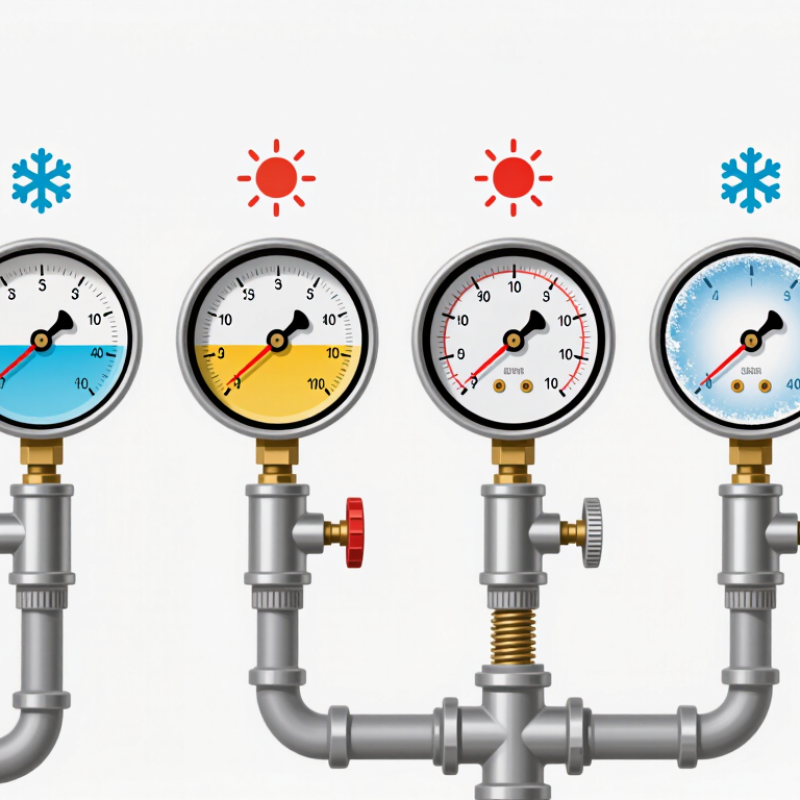
Before selecting a liquid-filled pressure gauge, map the actual conditions at its mounting point. Record ambient temperature swings, vibration, pressure pulsation, moisture, and possible chemical splash. Silicone and glycerin fills behave differently across temperature ranges, so verify the specified operating limits rather than assuming any fill will work. In cold weather, thickened fill can slow pointer movement. In hot locations, expansion may affect the case. Small details matter.
Maintenance access matters too. A gauge mounted behind hot pipework may be difficult to inspect, even if its range is correct. Check for leaks, cloudy fill, a bent pointer, and readings that do not return to zero. The U.S. Department of Energy’s Operations & Maintenance Best Practices Guide reports typical predictive-maintenance savings of 8–12% over preventive maintenance. This is a facility-wide benchmark, not a gauge-specific guarantee, but it supports planned inspection over waiting for failure. Records help reveal drift. They are not perfect.
Tips: Keep a simple log of readings and inspection dates. Compare the gauge with a reference instrument when readings seem inconsistent. Follow the instrument’s stated temperature limits, and set inspection intervals according to process risk and operating history. A rushed check can miss a slow leak.