
Choosing a Chicken Injector in 2026 starts with the way you cook, not the number of features on a box. A compact model may suit occasional roasting, while a larger barrel can reduce refills for several birds. But capacity is not everything. Hold the injector, if possible, and check whether its grip feels steady with wet hands. A smooth plunger, clear measurement marks, and a secure connection between barrel and needle can make filling and dosing easier. Small details matter.
Next, consider what you plan to inject. Thin marinades pass more easily through narrow needles; mixtures with herbs or spices may need a wider opening or finer straining. Check that the included needles match your recipes and are easy to remove for cleaning. Food-contact materials, dishwasher guidance, replacement parts, and the maker’s instructions deserve a close look. Do not assume every component is dishwasher-safe. That assumption can be costly.
A reliable Chicken Injector should be simple to take apart, clean, and reassemble, with no hidden spaces that trap residue. Compare warranty terms and customer support, not just price. A premium kit is not automatically better for a home cook. Nor is the cheapest option always a bargain if needles bend or seals wear quickly. Think about storage, too: a case can keep small parts together in a crowded kitchen drawer. Your needs may change. Review your usual recipes before buying, and be honest about how often you will use it.
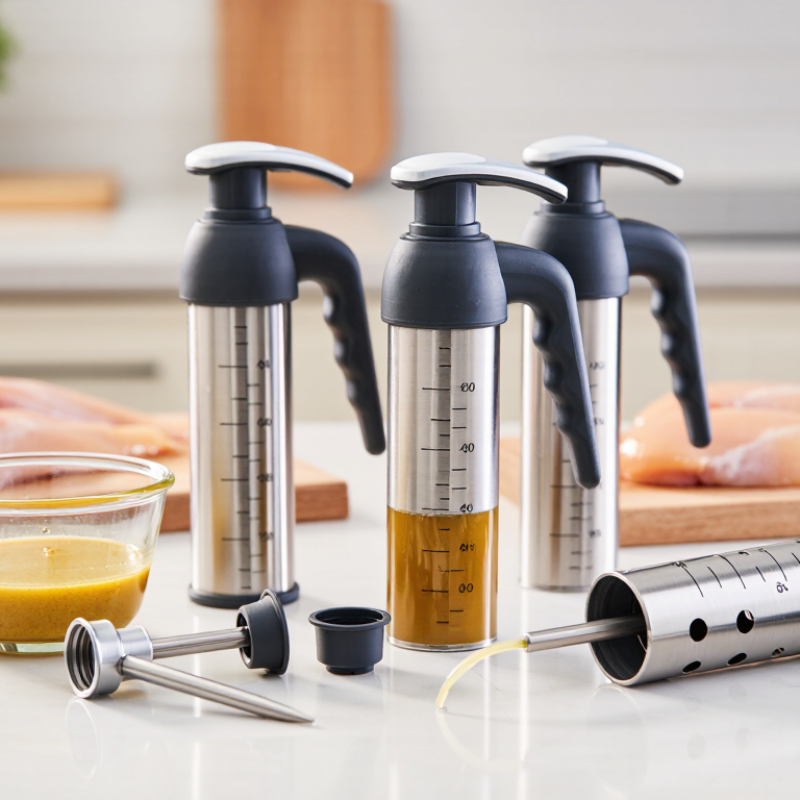
A chicken injector pushes measured marinade or brine through a needle into muscle, rather than leaving flavor only on the surface. It can improve seasoning distribution and help retain moisture, but poor technique creates salty pockets or torn meat. That matters. A USDA National Agricultural Statistics Service Poultry Slaughter report recorded about 9.4 billion broilers slaughtered in 2023; USDA Economic Research Service outlooks place annual U.S. broiler production near 47 billion pounds. Those figures describe a large, varied processing sector, not a guarantee that every injector performs equally well.
A manual single-needle injector suits occasional home use and small batches. You control each placement, though even spacing takes practice. Multi-needle injectors treat several points at once and suit repeated, higher-volume work; they need careful cleaning and pressure checks. Pump-fed systems move brine from a tank through needles, making flow and repeatability easier to manage at production scale. Their added parts also mean more maintenance. For a whole bird, needle length and spacing matter: a few deep injections can leave uneven seasoning, while too many may damage the texture. I would not choose by needle count alone. Check adjustment, disassembly, and whether the device handles the marinade’s particle size. Nothing fancy. A simple injector that cleans thoroughly may be more dependable than a complex unit that is difficult to inspect.

Choose injector capacity by the amount of chicken you prepare, not by the largest number on the package. A 30-milliliter model is often manageable for one or two breasts, while a larger barrel means fewer refills for whole birds or batch cooking. Too much capacity can feel awkward in a small hand. It can also encourage overfilling.
Needle design matters just as much. A narrow, single-opening needle gives controlled placement in thick breast meat and is usually easier to rinse. Multi-hole needles spread marinade across a wider area, which can help with larger cuts, but thick mixtures may block the openings. Keep herbs finely chopped, and avoid pastes with seeds or coarse pepper. Small details matter.
For even flavor, insert the needle at several angles and press the plunger slowly. Stop if liquid leaks back; the injection point may be too shallow, or the volume too large. Clean the barrel and needle promptly, using the small brush if one is supplied. Check that the needle threads securely and does not wobble. I sometimes prefer a smaller injector, even for a whole bird. It takes longer, but gives me better control. That trade-off is personal.
| How to Choose a Chicken Injector in 2026? — Which Capacity and Needle Design Suit Your Cooking Needs | |||||
|---|---|---|---|---|---|
| Capacity | Approximate Volume | Best Suited To | Needle Design to Consider | Practical Advantages | Things to Check |
| 1 oz | 30 mL | Small portions, chicken breasts, or occasional home use | Slim needle with a single opening for thin, well-strained marinades | Compact and easy to control when injecting a small amount at a time | Requires more refills for a whole chicken; avoid chunky or thick mixtures that may clog the needle |
| 2 oz | 60 mL | Regular home cooking, several chicken pieces, or a small whole bird | Slim single-opening needle for thin liquids; a side-port needle can help distribute liquid within the meat | A manageable balance between capacity and handling for everyday batches | Check that the plunger moves smoothly and that the needle can be removed for cleaning |
| 4 oz | 120 mL | Whole chickens, larger batches, or frequent roasting and smoking | Interchangeable needles are useful: a slim needle for thin brines and a wider-bore needle for thicker marinades | Holds more liquid, so fewer refills may be needed during preparation | A larger barrel can be heavier when full; confirm that replacement seals and compatible needles are available |
| 6 oz | 180 mL | Large batches or cooks who inject several birds in one session | Wide-bore or multi-port needle for suitable, smooth marinades; use a slim needle for thinner liquids | Higher capacity can reduce interruptions during batch preparation | Can be bulky to handle and is not automatically more precise; make sure the marinade is strained and the tool is easy to disassemble |
| Any capacity | Choose based on batch size | Thin brines, stock, or finely strained liquid seasonings | A narrow, smooth needle with an open tip or small outlet | Works well with low-viscosity liquids that can pass through a small opening | Large herbs, pepper pieces, and other solids can block narrow passages |
| Any capacity | Choose based on batch size | Thicker marinades that have been blended smooth | A wider-bore needle; a side-port design can release liquid through openings along the needle | Provides a larger passage for thicker liquids than a slim needle | Strain the mixture first. Multiple side openings are not a substitute for a sufficiently wide bore if the liquid is too thick |
How to Choose a Chicken Injector in 2026?
When comparing chicken injectors, check the barrel, needle, and seals rather than judging by appearance alone. A stainless-steel needle resists corrosion, while a clearly labeled food-safe barrel is easier to assess. Look for smooth inner surfaces and seals that can be removed without tools. Tiny crevices can hold grease. Small details matter.
Grip is important when your hands are damp or oily. A broad handle with gentle texture can feel steadier than a slick, narrow one. If possible, hold the injector before buying and press the plunger a few times. It should move smoothly without wobbling. A very firm plunger may feel reassuring at first, but it can tire your hand during repeated injections.
Cleaning deserves equal attention. Choose a model that comes apart easily and has a needle wide enough for the marinades you actually use. Fine herbs or pepper flakes may clog narrow openings, so strain chunky mixtures when needed. Check the care instructions before using a dishwasher; heat can damage some seals or plastic parts. One trade-off is easy to miss: extra needles sound useful, but they add more parts to wash and store. A simple design may be less impressive, yet more practical after dinner.
How to use this chart: These are approximate raw-material densities in g/cm³, not the weight of finished injectors. A lighter material does not automatically mean a better injector. For grip, look for a comfortable handle with a nonslip texture. For easier cleaning, check that the barrel and needle come apart and that the manufacturer specifies which parts are dishwasher-safe.
Approximate reference values; density varies by alloy, grade, and formulation.
How to Choose a Chicken Injector in 2026?
How to Match Injector Features to Your Recipes and Budget
Match capacity to the way you cook. For a single roast chicken, a compact injector with clear measurement marks can help control each dose. For a large bird or several meal-prep portions, a larger barrel means fewer refills. A stainless-steel needle is useful for thicker marinades, while a fine needle suits strained, thinner liquids. Check that the needle detaches for cleaning; small openings can trap herbs and garlic. You may not need a large kit. I still find it easy to overbuy accessories I rarely use.
Tips: Test the marinade through a glass of water first. If pepper flakes clog the needle, strain the mixture or choose a wider opening. Compare replacement needle availability and cleaning instructions before paying extra for bundled parts. A comfortable plunger matters when injecting several spots.
Budget should reflect frequency, not just the listed price. Occasional cooks can prioritize easy disassembly and a reliable seal; frequent cooks may value sturdier construction and spare needles. Injection adds flavor, but does not replace safe cooking. The USDA Food Safety and Inspection Service’s Safe Minimum Internal Temperature Chart sets poultry at 165°F; verify the thickest part with a food thermometer. A glossy marinade can make doneness look closer than it is.
A chicken injector should feel safe and predictable in your hand, not just offer a large capacity. Check that food-contact parts are clearly identified and that the needle locks firmly onto the barrel. A loose connection can leak marinade across your fingers or work surface. Look for smooth edges, a steady plunger, and a grip that stays secure when damp. Small details matter. If possible, test the mechanism with water before use; uneven resistance may signal a poor seal or awkward assembly.
Durability depends on more than the material label. Inspect the needle for bending, the barrel for cracks, and seals for parts that can be replaced. Stainless steel can resist corrosion, but it still needs prompt washing and thorough drying. Choose a design that comes apart without tools and has no narrow crevices that trap herbs or fat. Follow the maker’s cleaning instructions, and avoid assuming every part is dishwasher-safe. I might give capacity too much weight at first; in practice, easy cleaning can matter more. Check that replacement needles and seals are available, since a worn seal can turn a useful tool into a leaky one.
3295 Cobb International Blvd.
Kennesaw, GA 30152
800-367-1377
sale@patiostools.com
© 2023 - Marsh Instruments