2026 How to Choose the Best Puppy Collar?
A puppy’s first collar looks like a small purchase. It is also the point where comfort, safety, and daily training meet. The American Pet Products Association’s 2025–2026 National Pet Owners Survey reports that 94 million U.S. households own a pet, underscoring the scale of everyday pet-care decisions. That figure is not collar-specific, but it helps explain why reliable fit advice matters to so many families.
A Puppy Collar should sit securely without rubbing a growing neck. A practical fit check: you should be able to slide two fingers beneath the collar, then check again as your puppy grows. Veterinary behaviorist Dr. Karen Overall’s work emphasizes matching handling choices to an individual dog’s welfare and behavior. Put simply, comfort comes before appearance. This is a guiding principle, not a direct quotation from her.
In the sections ahead, we’ll compare collar materials, closures, widths, and adjustment ranges, then explain what to check during a real fitting. Look for edges that do not scrape, hardware that stays fastened, and enough adjustment for growth. A collar that feels fine in a shop may rub after a lively walk in the rain. Small details matter. No single style suits every puppy, and product labels alone cannot guarantee a safe fit. Check the collar often, especially during rapid growth, and ask your veterinarian for advice if the fit or your puppy’s skin concerns you.
Understand Your Puppy’s Age, Size, and Collar Needs
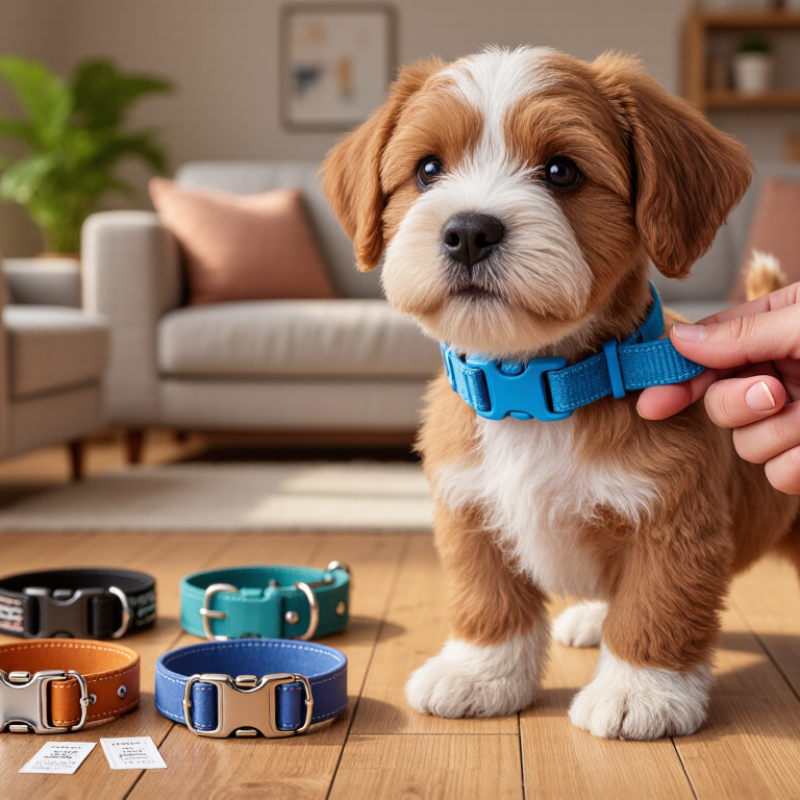
A puppy’s collar should fit the body they have today, not the adult size you expect later. Puppies grow quickly, so check the fit every few days, especially during growth spurts. You should be able to slide two fingers between the collar and your puppy’s neck without forcing them. Too tight can rub or restrict movement; too loose may slip over the head. Very young puppies may need time to get used to wearing one. Keep early sessions brief and supervised.
Tips: Choose a lightweight collar with smooth edges and an adjustable fit. Check the neck for redness or rubbed fur after wearing it. A small identification tag can help, but make sure it does not hang low enough to catch on objects. For leash walks, consider whether your puppy pulls; pressure on a growing neck may be uncomfortable, so ask your veterinarian about suitable options.
Age and size matter, but so does temperament. A shy puppy may benefit from calm, short practice sessions indoors, while an active puppy needs frequent fit checks and secure fastening. Replace the collar if it frays, cracks, or becomes difficult to adjust. I’ve found that “it fits today” can be misleading after a week of growth. Check again.
Compare Collar Styles for Different Puppy Activities
A collar should match the activity, not just the puppy’s size. For everyday walks and ID tags, a lightweight, flat buckle collar is often practical for a puppy already learning to walk calmly on leash. APPA’s 2023–2024 National Pet Owners Survey reports 65.1 million U.S. households own dogs. That figure measures ownership, not collar injuries, but it shows how many dogs need thoughtful everyday gear. Fit changes fast. Check the collar weekly as your puppy grows; you should be able to slide two fingers beneath it without it slipping over the head.
For hikes or energetic play, a well-fitted harness can reduce direct pressure on a young dog’s neck. It is not escape-proof by default. Check for rubbing behind the front legs, especially after a longer walk. A martingale collar may suit a puppy prone to backing out of a flat collar, but use it under supervision and adjust it carefully. For swimming, remove a wet collar afterward and dry the coat beneath it; damp, trapped fur can irritate skin. I’ve found that puppies can outgrow a “perfect” fit in a surprisingly short time. For unusual neck shapes, skin sensitivity, or persistent pulling, ask a veterinarian or qualified trainer to assess the fit and walking setup.
2026 How to Choose the Best Puppy Collar?
Compare Collar Styles for Different Puppy Activities
How to read this chart: Scores are general practical guidance on a 1–5 scale, not results from a standardized test. A flat collar is commonly used for identification; a properly fitted harness is often a better choice for leash walking, especially for puppies that pull. Supervise puppies wearing collars during play, and check fit as they grow.
Measure Your Puppy for a Safe, Comfortable Fit
Measure Your Puppy for a Safe, Comfortable Fit
A collar that fits today may pinch next week. Puppies grow quickly, and neck size can change before the collar looks too small. Use a soft tape measure around the middle of the neck, where the collar will sit. Keep the tape snug, not tight, and note the measurement. A 2020 Veterinary Record study tested seven collar types on nine dogs. Under leash tension, every type created neck pressure that researchers considered potentially harmful. A good fit helps, but it cannot prevent pressure when a puppy pulls.
Tips: Fit the collar so two fingers slide comfortably between it and your puppy’s neck. Check that it cannot slip over the head, especially when your puppy backs away. Recheck the fit every week during rapid growth, and inspect the skin for redness or rubbed fur. Remove the collar if you see irritation. Small details matter.
It is easy to trust yesterday’s fit. That can be a mistake. Check again after meals, naps, or a growth spurt, when the collar may sit differently. Replace it when the adjustment range no longer allows a secure, comfortable fit.
Assess Collar Materials, Fasteners, and Safety Features
Choose soft, tightly woven nylon or smooth leather with finished edges. Run your fingers along the inside seam; rough stitching can rub a puppy’s neck during a walk. Washable material helps after muddy play, though it may hold moisture if left damp. Fit matters more than appearance. You should slide two fingers beneath the collar, then check the fit every week as your puppy grows. Easy to miss.
Fasteners should close firmly and release without sticking. Test the buckle several times, and inspect stitching and attachment rings for fraying, cracks, or sharp edges. A metal ring should lie flat, not press into the throat. For leash walks, use a secure collar or a well-fitted harness; a breakaway collar may open if it catches, allowing a puppy to escape. Small details matter.
Safety evidence deserves careful reading. A 2006 study in the Journal of the American Animal Hospital Association tested 26 dogs and reported increased eye pressure when leash tension was applied through a neck collar, particularly in dogs with glaucoma. The study was small and measured eye pressure, not collar injuries, so it cannot predict risk for every puppy. Still, avoid jerking the leash, and ask your veterinarian about harness use if your puppy has eye or airway concerns. A collar can look secure and still fit poorly.
Choose and Adjust a Collar as Your Puppy Grows
2026 How to Choose the Best Puppy Collar?
Choose and Adjust a Collar as Your Puppy Grows
A puppy’s collar should fit today, not just look ready for the months ahead. Measure around the middle of the neck with a soft tape, then check the fit after fastening. You should be able to slide two fingers beneath it without forcing them. Too tight can rub the skin; too loose may slip over the head. Check for redness, missing fur, or dampness under the collar. Puppies grow in uneven bursts, so a fit that seemed fine last week may not be fine now.
Tips: Check the fit every few days, and after bathing or grooming. Look closely at the buckle, stitching, and adjustment slider. If your puppy pulls away, pause and try again gently. A brief, calm fitting is usually more useful than a wrestling match.
As your puppy grows, loosen the collar gradually and recheck that it stays secure. A collar should not restrict swallowing or breathing, and you should be able to remove it quickly. For a young puppy, supervised practice helps them get used to the feel. Collars can catch on crate bars or play equipment, so consider removing one during unsupervised rest, following your veterinarian’s safety advice. I have sometimes trusted a quick glance too much; running your fingers around the whole neck catches problems your eyes can miss.