
Choosing the right Portable Electric Winch is rarely as simple as comparing pulling capacity and price. Global buyers face different vehicle weights, battery systems, climates, mounting spaces, and service conditions. A winch that performs well on a dry construction site may struggle in coastal humidity or freezing terrain. Small details matter. Cable length matters.
Recovery-equipment trainer David J. Anderson offers a practical warning: “A winch is only as reliable as its setup.” This principle guides the buying decisions covered in this article. Buyers should examine rated line pull, duty cycle, motor temperature, gearbox protection, rope material, brake performance, and control options. They should also confirm voltage compatibility and mounting dimensions before placing an order. A powerful motor cannot correct a weak battery or poorly aligned fairlead.
This guide is written for importers, fleet managers, outdoor professionals, and careful individual users. It considers product specifications, supplier communication, documentation, warranty support, and realistic operating conditions. Weather changes. Loads vary. Human judgment is imperfect. That deserves honest attention.
Some advertised ratings may sound impressive but lack useful testing details. Ask difficult questions. Request clear manuals and test information. Check replacement-part availability before purchase. A Portable Electric Winch should be evaluated as a complete working system, not as an isolated machine. Price remains important, but dependable performance, safe operation, and long-term service usually matter more. The best choice may not be the strongest model. It may be the model you can install, operate, inspect, and repair correctly.
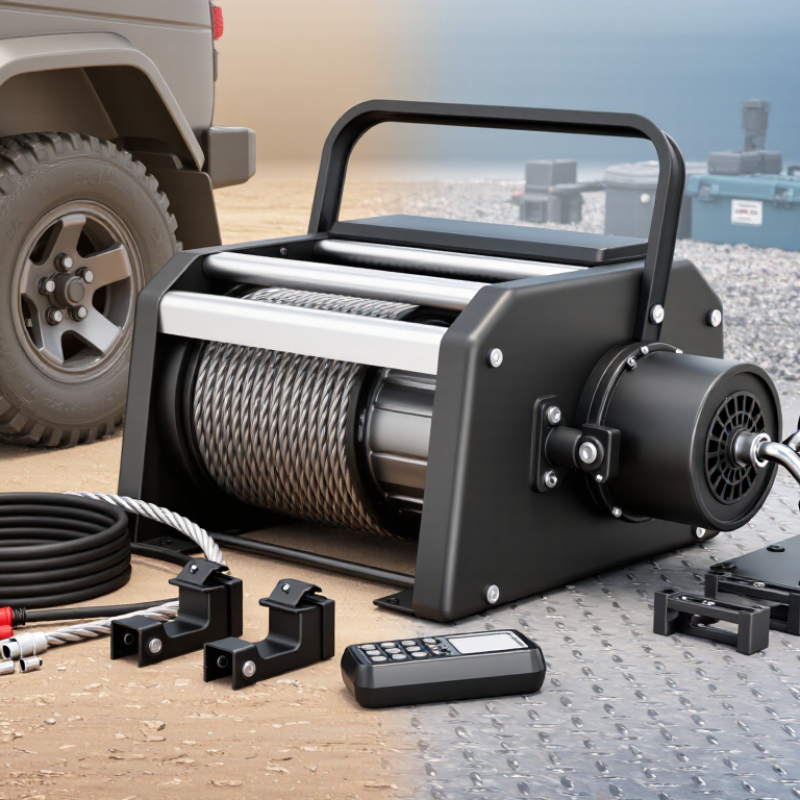
A portable electric winch is a compact pulling machine powered by a battery or external electrical source. Its motor turns a gearbox, which rotates a drum and winds a steel cable or synthetic rope. A clutch allows free-spooling, while a brake holds the load when power stops. The operator controls direction through a wired or wireless switch. Simple in principle, but real performance depends on friction, rope angle, battery voltage, and drum position.
Market research supports growing demand for compact recovery equipment. Grand View Research estimated the global winch market at about USD 1.8 billion in 2023, with growth expected through 2030. However, reports use different market boundaries, so buyers should avoid treating forecasts as exact.
Check the rated line pull, not only the advertised peak figure. A practical rule is keeping routine loads well below maximum capacity. I have seen buyers overlook this detail. Heat appeared quickly during repeated pulls. Duty cycle, thermal protection, waterproofing, and battery reserve matter in the field. A winch rated for 4,500 pounds may pull far less from the first cable layer. Follow the installation and inspection guidance in ASME B30.7 where applicable, and verify local safety requirements before operation.

Before buying a portable electric winch, compare rated pulling capacity, not the advertised maximum. A practical rule is to select a capacity at least 1.5 times the vehicle’s gross weight on level ground. On mud or a 30-degree slope, resistance can rise sharply. Grand View Research’s 2024 material-handling equipment analysis identifies load control and energy efficiency as major purchasing factors. This supports checking the winch’s continuous-duty rating, not only its peak figure.
Look closely at line speed under load. A unit pulling 3 meters per minute at rated capacity may feel slow in wet sand. Confirm rope length, rope diameter, and construction. Synthetic rope is lighter, but it needs careful inspection for cuts and heat damage. Steel cable tolerates abrasion better, yet it adds weight and can develop sharp broken wires. The brake should hold the stated load without drifting. It should also release smoothly.
Battery demand is easy to underestimate. A 12-volt winch drawing 300 amps can drain a small battery quickly. Compare amp-hour requirements, fuse size, cable length, and connector temperature limits. The IP rating matters in rain, but IP protection does not excuse poor storage. A 2023 MarketsandMarkets report links durable equipment demand with harsher operating environments. That sounds convincing, but field conditions vary. Test the winch with a real load before relying on its published numbers. Safety margins are not wasted capacity.
| Specification | Light-Duty Portable | General-Purpose Portable | Heavy-Duty Portable | What Global Buyers Should Compare |
|---|---|---|---|---|
| Rated Line Pull | 900–2,000 kg 2,000–4,400 lb | 2,000–3,600 kg 4,400–8,000 lb | 3,600–5,400 kg 8,000–12,000 lb | Compare the rated pull on the first rope layer, not only the maximum or stall rating. For vehicle recovery, the winch capacity is commonly selected at least 1.5 times the vehicle's gross weight, with actual requirements affected by slope, mud, and ground resistance. |
| Power Supply | 12 V DC | 12 V or 24 V DC | 24 V DC Some systems support 12 V | Confirm the vehicle or battery-bank voltage. A 24 V system generally draws less current than a comparable 12 V system, but it requires a compatible electrical architecture. |
| Motor Output | 0.8–1.5 kW | 1.5–3.0 kW | 3.0–5.5 kW | Motor power is only one indicator of performance. Gear reduction, motor efficiency, battery condition, cable size, and operating temperature also affect actual pulling capacity. |
| Rope Type | Synthetic rope or galvanized steel cable | Synthetic rope or steel cable | Steel cable often preferred Synthetic rope available | Synthetic rope is lighter and easier to handle but needs protection from abrasion, heat, and ultraviolet exposure. Steel cable tolerates abrasion and heat better but is heavier and can develop sharp broken wires. |
| Rope Diameter | 5–8 mm | 8–11 mm | 10–13 mm | Diameter must match the winch drum, fairlead, rated pull, and replacement-rope requirements. Do not substitute a rope with a lower minimum breaking strength. |
| Rope Length | 10–15 m | 15–30 m | 25–45 m | Choose length according to the anchor distance and storage space. Longer rope increases reach but adds weight and may reduce the amount of rope that can be neatly stored on the drum. |
| Line Speed | 2–5 m/min under load | 2–6 m/min under load | 1.5–5 m/min under load | Check speed at a stated load and rope layer. No-load speed is substantially higher and is not a reliable indicator of recovery performance. |
| Duty Cycle | Intermittent Short pulls with cooling periods | Intermittent to moderate | Moderate to heavy intermittent | Portable DC winches are generally not continuous-duty lifting machines. Confirm the permitted pull duration, rest period, thermal protection, and motor temperature limits. |
| Gear System | Planetary or worm gear | Three-stage planetary or worm gear | Multi-stage planetary or robust worm gear | Planetary gears usually provide compact size and higher speed. Worm gears can offer strong holding characteristics but may be slower and less efficient. Verify whether a mechanical brake is fitted. |
| Braking System | Automatic mechanical brake | Automatic load-holding brake | Automatic brake with secondary protection | For pulling applications, confirm the rated holding capacity and brake performance. A winch intended for pulling should not automatically be treated as suitable for personnel lifting. |
| Ingress Protection | IP54–IP65 | IP65–IP67 | IP65–IP67 | IP ratings describe protection against dust and water under defined test conditions. Check whether the rating applies to the motor, solenoid, remote control, connectors, and complete assembly. |
| Typical Net Weight | 8–18 kg | 18–35 kg | 30–55 kg | Weight affects portability, mounting strength, shipping cost, and manual handling risk. Ask for the net weight, gross shipping weight, and packed dimensions separately. |
| Mounting Arrangement | Portable plate, receiver, or temporary anchor | Mounting plate or receiver hitch | Reinforced mounting plate or structural frame | Check mounting-hole dimensions, bolt grade, anchor points, fairlead alignment, and the supporting structure's rated capacity. The mounting system must withstand the full line pull. |
| Electrical Current | Approximately 80–180 A at high load | Approximately 150–350 A at high load | Approximately 250–500 A at high load | Actual current varies with voltage, load, motor efficiency, and rope layer. Compare recommended fuse size, cable gauge, battery capacity, grounding method, and connector rating. |
| Control Method | Wired remote Optional wireless control | Wired and wireless remote | Wired remote plus wireless backup | Look for an emergency stop or main isolator, a control range suitable for the work area, sealed connectors, clear direction markings, and protection against accidental activation. |
| Operating Temperature | About −20°C to +55°C | About −20°C to +55°C | About −20°C to +55°C | These are common declared ranges, not universal guarantees. Cold temperatures reduce battery performance, while high ambient temperature can shorten duty cycles and increase thermal overload risk. |
| Common Safety Features | Circuit breaker, brake, fairlead | Overload protection, brake, isolator | Thermal protection, overload control, brake, isolator | Prefer a load-rated hook with safety latch, clearly marked capacity, thermal or overload protection, an accessible isolator, and a fairlead suited to the selected rope. |
| Documentation to Request | Manual and wiring diagram | Manual, test data, spare-parts list | Manual, test data, conformity documents, service information | For international purchasing, request rated-load test results, dimensional drawings, electrical diagrams, packing details, warranty terms, spare-part availability, and applicable conformity documentation. |
| Best-Fit Applications | ATV or trailer assistance, light equipment positioning, occasional anchoring | Vehicle recovery, utility trailers, small boats, landscaping and construction equipment | Heavy vehicle recovery, industrial equipment movement, off-road and demanding outdoor use | Select according to the actual load, environment, frequency of use, anchor strength, and required portability—not by maximum pulling capacity alone. |
| Important: The ranges above are typical market-level comparison ranges rather than a specification for a particular model. A portable electric winch is normally designed for pulling or recovery; use for vertical lifting or personnel handling requires equipment specifically certified and rated for that purpose. | ||||
Choosing a portable electric winch starts with the application, not the advertised pulling capacity. A vehicle recovery setup may need high peak power, while a boat trailer usually benefits from smoother, controlled movement. For workshop tasks, compact size and precise line speed can matter more than maximum force. Do not confuse pulling capacity with lifting capacity.
Check the load, surface, and distance before selecting a model. Mud, gravel, slopes, and rolling resistance can increase the required force. A practical safety margin of at least 25 percent is sensible, although real conditions can demand more. Shorter cable pulls usually preserve battery power. Longer pulls may need a larger battery, thicker wiring, or cooling pauses. Small details matter.
Inspect the mounting point and anchor path carefully. The winch should sit on a rigid base, with the cable winding evenly across the drum. Wireless controls are convenient, but a manual backup can be valuable when batteries fail. Look for weather protection if the unit will face rain, spray, or dust. For frequent use, study duty cycle, brake performance, replacement cables, and service access. A common mistake is choosing the lightest unit for easy carrying, then discovering its motor overheats after one demanding pull. That trade-off deserves honest reconsideration. Never use a portable winch to lift people, and keep bystanders away from a tensioned line.
A portable electric winch should have a clearly marked rated capacity, overload protection, and thermal cutoff. These features reduce motor damage during demanding recovery work. Choose a unit with an emergency stop and a reliable remote control. Keep your hands away from the drum. A guarded control prevents accidental activation during setup. Check the voltage, battery requirements, and environmental rating before purchase. Product markings should be easy to read, even in poor light.
Inspect the rope, hook, fairlead, and mounting points before every operation. Look for crushed sections, broken strands, bent hooks, or loose fasteners. Wear gloves and eye protection. Stand outside the rope’s direct line. Never allow people to stand near a loaded rope. Use a rated anchor and a steady pulling angle. Do not exceed the winch’s capacity, especially on slopes or muddy ground. A straight pull is usually safer and more efficient.
Keep the motor within its stated duty cycle, with regular cooling pauses. Disconnect power before clearing a jam. Moisture, sand, and road salt can cause hidden damage. I have seen operators trust a new-looking rope too quickly. That assumption is risky. Read the operating instructions and keep replacement parts available. Local electrical requirements and safe-use rules may differ, so confirm them before field work. Practice with a light load first. Mistakes become expensive when the load is already moving.
Top Portable Electric Winch Buying Guide for Global Buyers
Global purchasing requires more than comparing pulling capacity and price. The International Labour Organization reports 2.78 million work-related deaths annually, with many incidents linked to unsafe equipment and work practices. A portable electric winch should therefore include rated capacity, duty cycle, rope specifications, emergency stopping, and overload protection. Check the rating under realistic conditions. A muddy slope changes everything.
Certification depends on the destination market. European buyers should verify applicable CE requirements, technical files, and conformity declarations. Electrical safety and electromagnetic compatibility documents should match the exact model, voltage, and accessories. Buyers in Britain may need UKCA-related compliance, while North American projects often reference OSHA requirements and applicable ASME standards. Certificates are not enough. Confirm the testing laboratory, report number, production model, and certificate validity.
Maintenance planning protects both performance and evidence of compliance. Inspect the rope for crushed strands, corrosion, birdcaging, and damaged hooks before every demanding lift. ISO 4309 provides widely used rope inspection and discard guidance, although the manufacturer’s manual remains essential. Record operating hours, load cycles, repairs, and inspection findings. Keep photos.
A 2023 industry safety review by the International Labour Organization emphasizes training, risk assessment, and preventive controls. In practice, operators still skip records after quiet shifts. That is a costly weakness. Spare fuses, remote controls, brake parts, and compatible batteries should be available locally. Customs delays can stop a project faster than motor failure.
The chart converts common rated line-pull classes from pound-force (lbf) to kilonewtons (kN) using 1 lbf = 4.44822 N. Actual pulling capacity depends on rope layer, line angle, battery condition, duty cycle, and the manufacturer's rated configuration.
For international purchasing, confirm the required conformity documentation for the destination market, such as applicable electrical safety, electromagnetic compatibility, radio, machinery, and ingress-protection requirements. Before operation, inspect the cable, hook, mounting points, controls, battery connections, and brake function; follow the product-specific service schedule and never exceed the rated load.
3295 Cobb International Blvd.
Kennesaw, GA 30152
800-367-1377
sale@patiostools.com
© 2023 - Marsh Instruments