
China’s reinforcing steel bars industry combines large-scale production with increasingly sophisticated quality control. This makes supplier selection important for contractors, engineers, and international buyers.
This guide examines China’s top 10 Reinforcing Steel Bars manufacturers through practical criteria. These include production capacity, steel grades, testing systems, delivery records, and export experience. It also considers whether each company can provide heat-number traceability, mill test certificates, and consistent rib geometry. Small details matter. A poorly controlled bar can affect bond strength, bending performance, and jobsite reliability.
Professor David Darwin, a former president of the American Concrete Institute, has stated, “The quality of a reinforced concrete structure depends on its design, detailing, materials, and construction.” That principle remains highly relevant when comparing Chinese manufacturers. A modern rolling mill may look impressive, but equipment alone does not prove dependable performance. Buyers should review independent test results, ISO certifications, chemical composition, yield strength, elongation, and batch consistency.
The ranking is not absolute. Market conditions change. A manufacturer with excellent domestic capacity may have limited overseas service. Another supplier may offer stronger documentation but smaller output. This is where careful judgment is necessary. Price should never be the only measure.
The following manufacturers are assessed from an evidence-based perspective. Their strengths, limitations, product ranges, and typical application areas will be considered. The goal is not to promote a single company. It is to help readers make a safer, more informed sourcing decision for bridges, buildings, foundations, and other reinforced concrete projects.
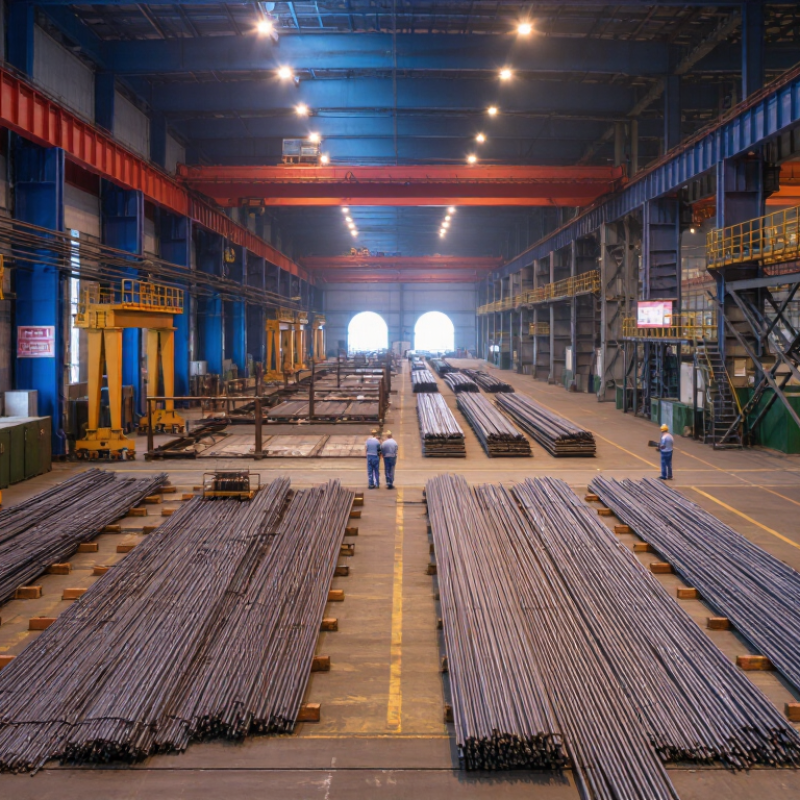
What Reinforcing Steel Bars Are and Why They Matter
Reinforcing steel bars, or rebar, give concrete the tensile strength it naturally lacks. Concrete handles compression well. It performs poorly when pulled, bent, or cracked. Ribbed bar surfaces improve mechanical bonding with surrounding concrete. A 16 mm bar weighs about 1.58 kg per metre, using the common d²/162 calculation.
Their value is structural, not decorative. Engineers select diameter, grade, spacing, lap length, and corrosion protection according to load and exposure. Standards such as GB/T 1499.2, ASTM A615, and BS 4449 define important requirements. The World Steel Association reported approximately 1.89 billion tonnes of crude steel production in 2023. This scale shows steel’s importance, but also its environmental cost. The association estimates steel contributes around 7% to 9% of global carbon dioxide emissions. Rebar decisions therefore affect both safety and embodied carbon.
Tips: Check the mill certificate, heat number, yield strength, elongation, bend performance, and dimensional tolerance. Inspect bundles before placement. Rust staining is not automatically dangerous, but flaky rust, oil, mud, or reduced diameter needs professional review. Keep bars off wet ground. Cover them during storage. The calculation is neat; site handling is not. A small spacing mistake can change crack control, and drawings are sometimes unclear. That deserves a second inspection, not a guess.
Standards-based comparison of widely used reinforcing steel bar grades and their key performance requirements
| No. | Applicable Standard | Typical Grade | Minimum Yield Strength (MPa) | Minimum Tensile Strength (MPa) | Minimum Tensile-to-Yield Ratio | Common Manufacturing Form | Typical Construction Use |
|---|---|---|---|---|---|---|---|
| 1 | ASTM A615/A615M | Grade 60 | 420 | 620 | 1.25 | Hot-rolled, deformed bar | General reinforced concrete construction |
| 2 | ASTM A706/A706M | Grade 60 | 420 | 550 | 1.25 | Controlled-chemistry, deformed bar | Seismic and weldable reinforced concrete structures |
| 3 | EN 10080 | B500B | 500 | 540 | 1.08 | Hot-rolled, ribbed bar | Structural concrete buildings and infrastructure |
| 4 | EN 10080 | B500C | 500 | 575 minimum | 1.15–1.35 | Hot-rolled, high-ductility ribbed bar | Seismic zones and structures requiring higher ductility |
| 5 | GB/T 1499.2 | HRB400E | 400 | 540 | 1.25 | Hot-rolled, seismic deformed bar | Chinese residential, commercial and infrastructure projects |
| 6 | GB/T 1499.2 | HRB500E | 500 | 630 | 1.25 | Hot-rolled, high-strength seismic bar | High-rise buildings, bridges and heavy infrastructure |
| 7 | JIS G 3112 | SD390 | 390 | 560 | 1.44 | Hot-rolled, deformed bar | Japanese-standard reinforced concrete work |
| 8 | JIS G 3112 | SD490 | 490 | 620 | 1.27 | Hot-rolled, high-strength deformed bar | Columns, bridges and heavily loaded structures |
| 9 | CSA G30.18 | 400W | 400 | 550 | 1.25 | Hot-rolled, weldable deformed bar | Canadian concrete buildings and civil works |
| 10 | AS/NZS 4671 | 500N | 500 | 540 | 1.08 | Hot-rolled, ribbed bar | Australian and New Zealand reinforced concrete construction |
Note: Strength values are representative minimum requirements stated by the listed standards. Actual dimensions, chemical composition, elongation, rib geometry, testing frequency and certification requirements depend on the applicable standard and purchase specification.

China’s rebar manufacturing industry has changed from capacity expansion to quality-driven production. Earlier, many mills focused mainly on volume and regional supply. Today, producers invest in automated rolling lines, digital quality control, and cleaner heating systems. These changes help improve diameter accuracy, surface consistency, and batch traceability.
Modern rebar plants often test chemical composition, tensile strength, elongation, and bend performance before shipment. Site inspections also examine bundling, marking, storage, and loading methods.
From practical procurement experience, small details matter. A poorly protected bundle can develop surface rust during long transport.
China’s industry has also responded to infrastructure upgrades, urban development, and stricter energy requirements. Yet progress is uneven. Some facilities remain less efficient, especially in older industrial areas. That gap deserves attention.
Tips: Ask for recent inspection records and mill certificates. Confirm the applicable standard before ordering. Compare actual production capacity, not only advertised output. Check whether the supplier can trace heat numbers from production to delivery. Samples help, but a factory visit reveals more. Buyers should also review packaging, lead times, and communication quality. These factors often decide whether a technically qualified order performs smoothly in the field.
China’s top 10 reinforcing steel bar manufacturers are typically assessed through production scale, quality systems, and delivery reliability. Leading producers commonly supply hot-rolled ribbed bars for bridges, towers, railways, ports, and residential structures. Their facilities often use automated rolling lines, laboratory testing, and heat-number tracking.
A dependable manufacturer should provide mill certificates, chemical analysis, tensile results, yield strength data, and bend-test records. Buyers should also verify compliance with the required national or international standard before placing an order. Useful checks include plant audits, sample testing, production capacity, and export experience. A serious supplier can explain bar grades, nominal diameters, bundle weights, length tolerances, and marking methods without vague promises.
Details matter. A 12-millimeter bar should be measured across several points, not just once. Surface ribs should appear consistent, while rust, deep scratches, and uneven ends deserve attention. Shipment planning also affects project costs; delayed loading can disrupt reinforcement schedules and concrete work. No list is perfect. Capacity figures may change, and a strong reputation does not guarantee every shipment will be flawless. Independent inspection remains sensible, especially for large orders, unfamiliar factories, or safety-critical projects. Experiences from site engineers often reveal practical issues that brochures omit.
This chart presents a factual technical benchmark for commonly used reinforcing steel bar sizes in China. It compares nominal mass per metre based on the GB/T 1499.2 standard rather than displaying company or brand data.
How to read the chart: As bar diameter increases, the nominal mass per metre rises significantly. This benchmark is useful for estimating material quantities, transport requirements, and structural steel consumption.
Comparing China’s leading rebar manufacturers requires more than ranking factory size. The World Steel Association reported that China produced about 1,005 million tonnes of crude steel in 2024. This scale shows strong industrial capacity, but it does not prove consistent rebar quality. Buyers should compare grade compliance, rolling technology, delivery records, and traceability.
Check whether each producer follows GB/T 1499.2 for hot-rolled ribbed bars. Ask for mill test certificates showing yield strength, tensile strength, elongation, chemical composition, and heat numbers. Independent laboratory results add confidence. Certification under ISO 9001 may support process control, but it should not replace product testing. The OECD’s latest steel market analysis also highlights persistent global overcapacity risks. Therefore, a very low quotation deserves careful review. It may reflect efficient production. It may also hide weaker inspection or uncertain delivery terms.
Request three recent test reports from different production heats. Compare actual results, not only the guaranteed minimums. Inspect rib patterns, bundle labels, and corrosion protection before shipment. Confirm whether the quoted weight uses theoretical or actual mass. A small difference can affect project costs. Also verify production capacity during peak construction months. A supplier may look impressive on paper, yet respond slowly when specifications change.
My practical view is incomplete: price remains important, but reliability is harder to measure and easier to underestimate.
When comparing China’s top ten rebar manufacturers, do not rank suppliers by website claims alone. Reliable selection starts with the project specification: bar grade, diameter, rib pattern, length tolerance, and required standard. Ask for recent mill test certificates, heat numbers, chemical composition, yield strength, tensile strength, and elongation. The heat number should connect each certificate to its bundle. Request production photos showing tagged bundles, weighing, and storage conditions. A clean yard matters because standing water can damage labels and complicate inspection.
Evaluate the factory’s quality system, not only its trading office. Confirm whether testing occurs in-house and whether calibration records are current. An independent pre-shipment inspection can verify diameter, mass per metre, bundle count, markings, and surface condition. Require a sample before approving a large order. Small details expose weak control.
Check export experience for your destination, container loading plans, documents, and realistic lead times. Very low prices deserve questions about grade, weight, or delivery assumptions. Ask who pays for re-testing if results disagree.
Communication is evidence. A capable supplier answers technical questions clearly and records changes in writing. Review payment terms, complaint procedures, replacement policy, and traceability after delivery. Search for audited financial and compliance information where available. Do not rely on one impressive video. Speak with recent buyers if references can be verified. I would compare several trial shipments, because an early order may hide handling weaknesses. No supplier is flawless. The useful test is how openly it handles a missed tolerance, delayed vessel, or corrected document.
3295 Cobb International Blvd.
Kennesaw, GA 30152
800-367-1377
sale@patiostools.com
© 2023 - Marsh Instruments