
Choosing the right Polyethylene Pipe Cutter can influence installation speed, cut quality, and long-term project costs. Global buyers often face dozens of similar tools, yet their differences become clear on the jobsite. A cutter that handles a 20-millimeter pipe may struggle with thicker PE tubing. Another may leave a crushed edge after repeated cuts. Small details matter.
This guide reviews ten leading options for international purchasing teams, contractors, maintenance professionals, and distributors. We consider cutting capacity, blade material, handle design, ratchet performance, portability, replacement parts, and manufacturer support. We also examine whether product information is clear enough for responsible comparison. Certifications, packaging, warranty terms, and regional availability deserve equal attention. They should be verified with suppliers before purchase.
No cutter wins everywhere. Some models suit occasional repairs, while others support daily utility or irrigation work. A lightweight tool may feel comfortable, but it could lack the strength required for dense, large-diameter pipe. A premium blade may produce cleaner cuts, although replacement costs can affect the final budget. That trade-off is easy to miss.
Our selection aims to provide practical, evidence-based guidance rather than exaggerated claims. Specifications can change. Supplier pages may remain incomplete. Buyers should confirm dimensions, compatible materials, shipping conditions, and after-sales support directly. A careful choice begins with the pipe, the workload, and the operator’s experience—not the product photograph alone.
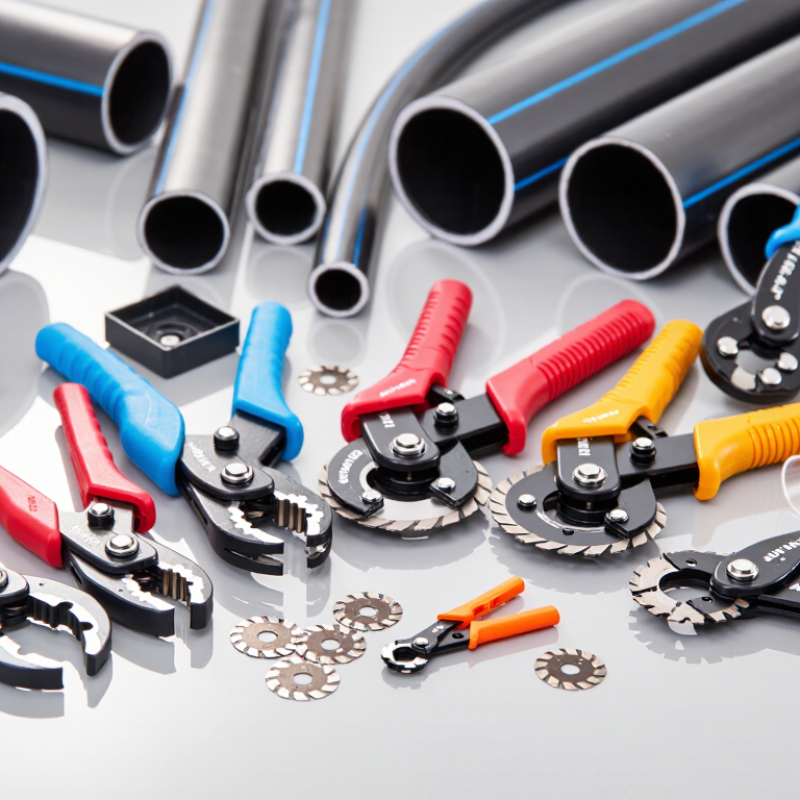
Polyethylene pipe cutters use different force paths, and the right mechanism depends on pipe diameter, wall thickness, and access. A ratcheting cutter advances a curved blade through repeated handle strokes. It suits smaller pipes and controlled work in tight spaces. Keep the pipe supported; otherwise, the blade can squeeze it oval before the cut finishes. Slow strokes help. A worn blade may still leave a slanted face, even when the cut looks clean from above.
Scissor-style cutters use direct handle pressure to drive a blade past an opposing jaw, making them simple for small-diameter tubing. Rotary cutters work differently: a wheel travels around the pipe, gradually cutting through its wall. For larger diameters, a guillotine-style tool pushes a straight blade across a supported pipe, while powered saws can handle thick sections but may leave chips or a rough edge. Not always ideal. After cutting, check that the end is square and free of deformation; a tidy-looking surface can hide a slight angle. Match the tool’s stated capacity to the pipe, and test the setup on a short offcut when possible.

Compare polyethylene pipe cutters by checking their stated diameter range against the pipe’s actual outside diameter and wall thickness. A tool that handles small service lines may struggle with thick-wall pipe. The cut should be square, with no crushed edge or hanging plastic. Poor cuts can complicate later joining work. Check the cutter’s instructions and the pipe manufacturer’s preparation requirements.
Blade quality and cutting control matter as much as capacity. A sharp, replaceable blade can reduce effort and leave a cleaner edge. Ratcheting models may suit larger diameters, while compact cutters are easier to carry between work areas. Test the handle grip with gloves if possible. A cutter that feels smooth in a showroom may be awkward in a damp trench. That detail is easy to overlook.
Tips: Check blade availability, locking features, and cleaning access before buying. Keep a sample pipe piece nearby when comparing models. Make a test cut and inspect it from several angles. If the edge looks uneven, adjust your technique or tool choice. Good cuts take practice.
| Rank | Cutter Type | Typical PE Pipe OD Range* | Power Source | Cut Quality and Squareness | Best Suited For | Key Advantages | Main Limitations |
|---|---|---|---|---|---|---|---|
| 1 | Ratcheting hand cutter | About 16–63 mm | Manual | Good on supported, smaller pipe; operator alignment affects squareness. | Small-diameter service, installation, and maintenance work. | Portable, simple to use, and requires no power supply. | Requires more effort as pipe size and wall thickness increase; blade condition matters. |
| 2 | Scissor-style plastic pipe cutter | Typically up to about 42 mm | Manual | Clean cuts on small, appropriately supported pipe; less suitable for thick walls. | Small PE tubing and light-duty field work. | Lightweight, quick to position, and easy to carry. | Limited capacity; squeezing can deform flexible or thin-wall pipe if poorly supported. |
| 3 | Manual guillotine cutter | Commonly about 20–160 mm | Manual, often lever-operated | Can produce a square cut when the pipe is clamped and the blade is sharp. | Small- to medium-diameter pipe preparation on site. | Controlled cutting action and no electrical supply required. | Capacity and effort depend on the design; bulky models are less convenient to transport. |
| 4 | Rotary wheel cutter for plastic pipe | Often about 20–110 mm | Manual | A guided wheel can provide a consistent cut; stable support helps prevent pipe movement. | Repeat cuts on compatible small- and medium-diameter pipe. | Compact design and controlled cutting around the pipe circumference. | Not all wheel designs suit PE pipe; check the specified material and diameter capacity. |
| 5 | Chain-type pipe cutter | Commonly about 110–630 mm, depending on design | Manual or powered drive | Can cut large pipe in the field; alignment and chain tension are important for a square cut. | Large-diameter pipe where access around the pipe is limited. | Wraparound design can be useful in trenches and restricted work areas. | Setup takes longer than with small hand cutters; capacity, cut speed, and finish vary by model. |
| 6 | Hand saw with pipe guide | Broad range; guide size determines practical capacity | Manual | A guide improves squareness; the result depends on the blade, technique, and pipe support. | Occasional cuts, remote locations, and sites without power. | Low equipment cost, portable, and useful across a range of pipe sizes with a suitable guide. | Slower and more operator-dependent than powered systems; may leave burrs or a rough edge. |
| 7 | Reciprocating saw with pipe-cutting guide | Guide-dependent; commonly used on medium and large pipe | Electric or battery-powered | A guide improves the cut angle; uncontrolled blade movement can reduce accuracy. | Field cutting when portability and speed are important. | Portable powered option; suitable blades are widely available. | Blade selection and firm support are essential; vibration can affect finish and squareness. |
| 8 | Portable band saw with pipe fixture | Typically small to medium diameters; limited by frame clearance | Electric or battery-powered | Can provide a controlled cut when the pipe is secured and the blade is appropriate for plastic. | Workshop or site work requiring repeatable cuts on compatible sizes. | Continuous blade action and a compact cutting path. | Frame capacity limits pipe size; an unsuitable blade or excessive heat can affect the cut edge. |
| 9 | Circular saw with pipe-cutting fixture | Fixture- and blade-dependent; used for medium to large pipe | Electric or battery-powered | A stable fixture can deliver a fast, square cut; alignment must be checked before cutting. | Production or construction sites with suitable space and pipe support. | Fast cutting and compatibility with appropriately selected plastic-cutting blades. | Requires secure setup and trained operation; exposed blade and chips require appropriate safety controls. |
| 10 | Orbital pipe saw | Model-dependent; available systems cover a wide range of diameters | Powered, usually electric | Clamping and guided rotation support consistent, square cuts for joint preparation. | Regular installation work and precise preparation for joining PE pipe. | Repeatable results and reduced dependence on freehand cutting. | Higher equipment cost and more setup than basic hand tools; verify pipe-size compatibility. |
*Capacity ranges are indicative examples, not universal specifications. Actual limits depend on the cutter design, pipe outside diameter, wall thickness, PE grade, blade or wheel type, and manufacturer instructions. For fusion or other joint preparation, follow the joining-system requirements and check that the cut end is square, clean, and free of burrs.
Choosing a polyethylene pipe cutter depends on pipe diameter, wall thickness, access, and required cut quality. Grand View Research’s 2023 HDPE Pipes Market report valued the global market at USD 19.3 billion and projected 5.8% annual growth through 2030. That scale reflects varied jobs, from irrigation repairs to municipal water lines. Clean cuts matter.
For small tubing, scissor cutters are compact; ratcheting shears and guillotine cutters handle thicker walls with less hand force. A rotary wheel cutter suits controlled cuts, while hinged rotary cutters help where pipe access is limited.
For medium and large pipe, a fine-tooth handsaw with a guide is affordable but needs careful alignment. Reciprocating saws with pipe guides work well in trenches, though vibration can leave an uneven edge.
Band saws offer steadier workshop cuts; low-speed circular saws suit supported pipe sections. Hydraulic cutters reduce effort on larger diameters, and specialist chain cutters can help in restricted spaces.
Check that each tool is rated for the pipe material and size. Not every cutter fits every wall thickness.
On site, support the pipe near the cut and mark a full line around its circumference. A square cut makes joining easier. Remove burrs and inspect the end before fitting.
Even a good tool can drift on a wet, muddy trench floor; rechecking the line is worth the extra minute.
For pressure systems, follow the pipe maker’s joining instructions and applicable standards.
Choosing among the top polyethylene pipe cutters requires more than comparing cutting capacity. Safety begins with a stable work surface, a sharp blade, and firm pipe support. Wear cut-resistant gloves and eye protection, especially when trimming large-diameter pipe. Keep fingers away from the closing path. Measure twice. Cut once.
Compatibility depends on pipe diameter, wall thickness, SDR rating, and polyethylene grade. A cutter suitable for PE80 may not perform equally on thicker PE100 pipe. Global buyers should check the tool’s stated range and cutting method before purchase. Rotary tools can leave a cleaner edge, while ratchet cutters may demand less space. Inspect the cut for crushing, angled edges, or deep scoring. These defects can affect joining quality. I have seen experienced workers overlook this inspection when production pressure rises.
Maintenance is simple, but often neglected. Remove plastic shavings after every job, then wipe the blade and pivot dry. Apply only a suitable lubricant, since excess oil can attract abrasive dust. Check blade sharpness, handle alignment, locking parts, and spring tension regularly. Store the cutter away from rain, salt air, and direct heat. Replace damaged blades rather than forcing a dull tool through the pipe. Manufacturer instructions and relevant technical standards should guide servicing intervals. In practice, no checklist is perfect; cold weather, muddy sites, and rushed handling can expose weaknesses that routine inspections miss.
Safety, compatibility, and maintenance comparison for common cutter designs
Scores are comparative benchmarks from 1 to 10 based on typical design characteristics: operator safety, suitability for polyethylene pipe, and maintenance simplicity. Actual performance depends on pipe diameter, wall thickness, cutting conditions, and tool specifications.
When selecting polyethylene pipe cutters, global buyers should match the tool with pipe diameter, wall thickness, and working conditions. A compact ratcheting cutter may suit service repairs, while large pipes require stable handles and stronger blades. Check whether the blade leaves a square, clean edge without crushing the pipe. Small defects can affect later fusion work.
Standards improve comparison, but they need careful interpretation. ISO 4427 and EN 12201 describe polyethylene piping systems, not every cutter feature. Ask suppliers to confirm compatible pipe sizes and provide dimensional test records. For quality control, review the supplier’s manufacturing system, inspection process, material traceability, and replacement-blade availability. A factory certificate alone is not enough.
Look closely at supplier performance. Request production samples, cutting videos, packaging details, and recent inspection reports. Test the cutter on pipes with different wall thicknesses before placing a large order. It should cut smoothly after repeated use, not only during a showroom demonstration. Confirm corrosion protection, handle comfort, spare parts, warranty terms, and export packaging. Delivery reliability also matters when projects cross borders. A low quotation may hide weak blades, limited support, or expensive replacements. I have found that purchasing teams sometimes compare price too early. That habit deserves review. Clear communication about tolerances, labeling, customs documents, and after-sales responsibilities reduces avoidable disputes.
3295 Cobb International Blvd.
Kennesaw, GA 30152
800-367-1377
sale@patiostools.com
© 2023 - Marsh Instruments