
3295 Cobb International Blvd. Kennesaw, GA 30152 800-367-1377 sale@patiostools.com

Product Variation:

What Are the Top Rectangular Fly Banner Types in 2026?

Fly Banners Rectangular offer a compact way to put a clear message above a busy walkway, storefront, or event booth. Their straight edges make logos, prices, and short calls to action easy to arrange. The right type still depends on the setting. A lightweight flag beside a pavement café faces different demands from a large banner at an outdoor sports event.

The Out of Home Advertising Association of America reported that U.S. out-of-home advertising revenue reached $9.1 billion in 2024, a 4.5% year-over-year increase. That figure covers the wider out-of-home sector, not rectangular fly banners alone. It does, however, show why brands continue investing in visible, physical displays. Small details matter. Fabric weight, pole structure, print method, and base choice can change how a banner looks in wind, sunlight, and close-up photographs.

Advertising expert David Ogilvy wrote, “The more informative your advertising, the more persuasive it will be.” His advice was not about fly banners specifically, so it should not be treated as technical guidance. It does offer a useful test: can someone understand the message while walking past? This guide compares the main rectangular types expected to matter in 2026, from compact single-sided models to heavier-duty event displays. It will look at use cases, practical trade-offs, and details buyers often overlook. No single type wins everywhere. A banner that works outside a shop may feel undersized on an open event field.
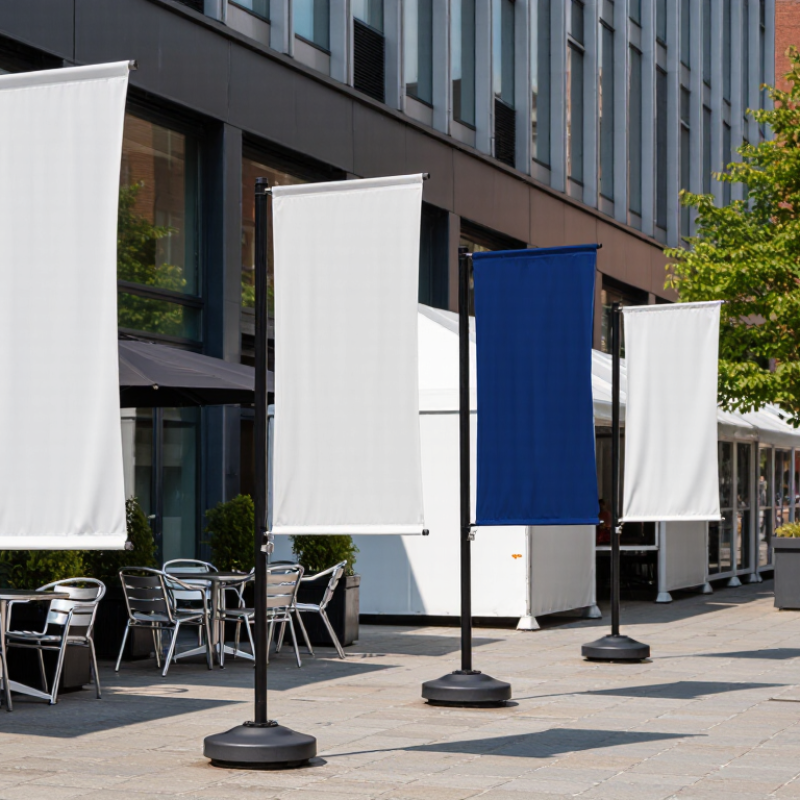
What Are the Top Rectangular Fly Banner Types in 2026?

How Rectangular Fly Banners Are Classified by Shape, Mounting, and Use

Rectangular fly banners are easiest to classify by their outline, support system, and intended setting. Their straight sides create a clear print area for names, prices, or directional messages. Some models are tall and narrow; others are wider, with more room for short lines of text. Check the finished dimensions, not just the product image. Small details matter.

Mounting choices affect where a banner works best. A ground spike suits grass or soft soil, while a weighted cross base is more practical on firm indoor floors. Wall brackets can keep displays close to a storefront, but they need a suitable fixing surface. On a windy pavement, even a sturdy base may shift. That part is easy to underestimate.

Use is another useful category. Retailers may place rectangular banners beside entrances, while event teams use them to mark registration points or guide visitors. For outdoor displays, look for weather-suitable fabric, secure stitching, and a base matched to the surface. Indoors, a lighter stand may be easier to move between rooms. A perfectly flat print is not guaranteed; fabric can crease during transport, and bright sunlight can make some colors look different. Check visibility from the viewing distance, not only up close.


Single-Sided vs. Double-Sided Prints: Fabric Layers and Show-Through

For 2026 rectangular fly banners, the choice between single-sided and double-sided printing comes down to viewing angle, fabric construction, and how much show-through you can accept. A single printed layer is lighter and often lets daylight pass through. From the reverse, the design may appear muted or mirrored, depending on the fabric and print method. That can work beside a wall, but look awkward in a busy walkway.

Double-sided banners typically place an opaque blockout layer between two printed faces. This reduces show-through and keeps each side readable, but adds weight and thickness. Ask for a fabric sample and inspect it against a bright window; studio photos can hide transparency. FESPA’s 2023 Print Census reported that 80% of surveyed print businesses expected growth. That is useful market context, not proof that one banner construction performs better. There is no universal fabric-layer standard, so compare the supplier’s stated material weight, opacity, and finishing details.

Tips: Check both faces in daylight and under venue lighting. Confirm whether the reverse is separately printed or merely shows through. A small test panel helps; I still find samples can behave differently once stretched outdoors.

Common Banner Heights: Comparing 2.5 m, 3.5 m, and 4.5 m Options

For rectangular fly banners in 2026, height affects visibility, handling, and where the display fits. Check whether the listed measurement includes the ground spike or base; suppliers may measure differently.

A 2.5 m banner suits compact entrances, indoor events, and narrow pavement areas. It is easier to carry and less likely to block nearby signs.

The trade-off is reach: people across a busy venue may not notice it.

A 3.5 m option often provides a practical balance. Its graphic can sit above shoulder-height crowds while remaining manageable for one person during setup. Leave enough clearance near doors, overhead structures, and walking routes.

Small detail, big difference.

The 4.5 m version offers stronger visibility across open grounds or large event spaces, but needs more room and a suitable base.

Wind changes everything.

A tall banner catches more air, so check the pole’s guidance and secure the base on the actual surface.

Height alone does not determine performance. Compare the visible print area, pole construction, base compatibility, and packed size before choosing.

For a sheltered indoor display, 4.5 m may be unnecessary; outdoors, even 3.5 m can feel unstable in gusts.

That part is easy to underestimate.

If possible, view the banner at full scale or mark its height on a wall before ordering. It is a simple check, though it will not predict every site condition.

Fabric and Print Specs: What 110–120 gsm Polyester Offers

For rectangular fly banners in 2026, 110–120 gsm polyester offers a useful balance of movement and substance. The fabric feels light in the hand but can hold a clean rectangular shape when tensioned correctly. In a breeze, it ripples rather than behaving like a rigid sign. That matters outdoors. Textile Exchange’s Materials Market Report 2024 estimates polyester accounted for 57% of global fibre production in 2023, indicating a well-established material supply. It does not mean every banner fabric has the same weave, finish, or lifespan.

For bright graphics, specify dye-sublimation printing and ask whether the fabric is knitted or woven; construction affects drape and edge stability. At this weight, single-sided printing may show a softer, reversed image through the back, so check a physical sample in daylight. Ask for the fabric weight, print method, and finishing details in writing. Check the stitched sleeve and seams, too. Small details matter. GSM alone cannot predict fade resistance or wind performance; exposure, ink, stitching, and care all play a part. A sample can reveal what a specification sheet misses. Even then, results vary.

Rectangular Fly Banner Fabric: 110–120 gsm Polyester

A comparison of three fabric weights within the 110–120 gsm range. Values in ounces per square yard are approximate conversions.

At 110–120 gsm, polyester is a lightweight option often used for fly banners. Fabric weight alone does not determine print quality or durability; weave, finishing, and printing method also matter. Specifications can vary by supplier.

Base Types and Site Conditions: Matching Supports to Indoor and Outdoor Use

For rectangular fly banners, choose the base for the surface and exposure, not appearance alone. On a smooth exhibition floor, a flat steel plate keeps the pole steady without spreading legs into walkways. A cross base is lighter to carry, but it may shift when visitors brush past. Add a water or sand weight only if the base is designed to hold it. Outdoors, ground spikes suit firm soil; weighted bases work better on paving where stakes cannot be driven. No base is universal.

Wind changes the calculation. NOAA’s Beaufort Wind Scale describes 13–18 mph winds as a “moderate breeze,” enough to raise dust and loose paper; at 25–31 mph, large branches move. A tall rectangular banner catches wind like a small sail, so those conditions warrant extra caution. ASCE 7-22 sets wind design values by location and exposure, reinforcing that one generic rating cannot cover every site. Check local forecasts, secure the base, and take the banner down when gusts exceed its rated conditions. A heavier base helps, but it is not a substitute for a wind limit. The awkward part: site conditions can change faster than setup plans.