
Why Choose a Folding Mesh Door for Global Buyers?
For global buyers, choosing a door is rarely a simple price decision. A Folding Mesh Door can balance access, ventilation, visibility, and space efficiency in one compact system. It folds beside the opening instead of swinging across a walkway. That matters in warehouses, retail entrances, clinics, patios, and service areas. Imagine a busy loading bay. Staff can see through the mesh, move carts safely, and close the opening without demanding wide clearance. Small details matter.
From practical experience, performance depends on more than the mesh itself. Buyers should check opening width, ceiling height, folding direction, track quality, roller movement, and frame strength. Measure twice. A sample installation can reveal issues that product photos hide. Smooth operation should remain consistent after repeated opening and closing. The mesh should also suit the local environment, especially where humidity, dust, or coastal air may accelerate wear. Supplier communication matters too. Clear drawings, installation instructions, spare-part availability, and responsive technical support create greater purchasing confidence.
Still, no folding system fits every building. Heavy industrial traffic, uneven floors, strong winds, or limited storage space may require another solution. A low-cost door can become expensive when repairs, delays, or replacement parts appear unexpectedly. Reliable global sourcing requires verified specifications, realistic lead times, quality inspections, and warranty terms that are easy to understand. Buyers should compare measurable performance, not attractive claims alone. This guide explores why a Folding Mesh Door may suit international projects, while also examining its limitations, installation requirements, and long-term value. Careful reflection is essential.
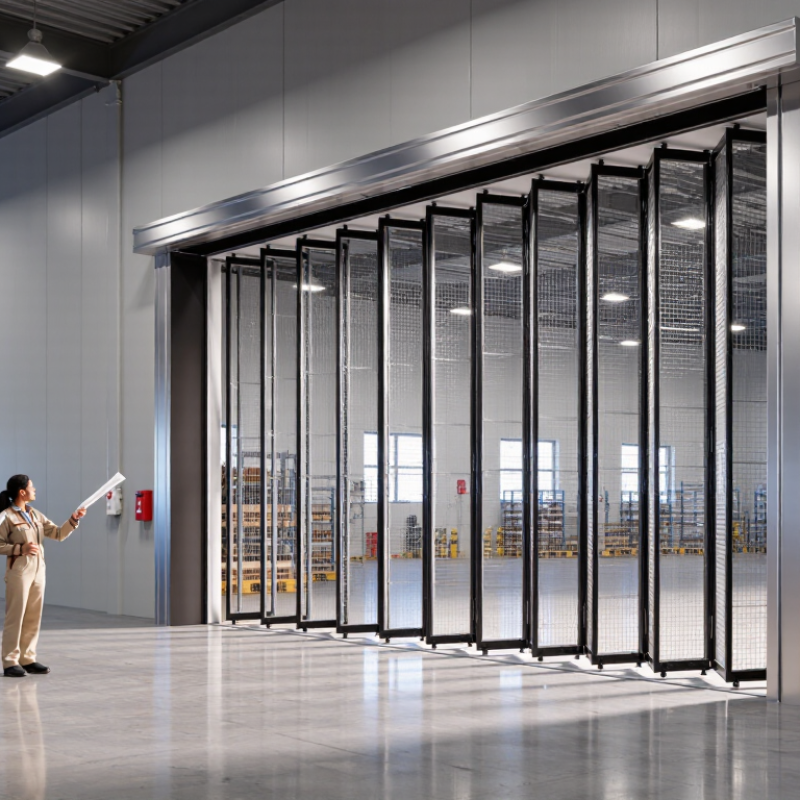
What Is a Folding Mesh Door?
A folding mesh door is a flexible barrier made from pleated mesh panels and a compact frame. Unlike a swinging door, it folds sideways along a track. The mesh allows daylight and fresh air to enter while helping reduce insects, dust, and unwanted outdoor contact. It can cover balconies, patios, kitchens, entrances, and interior openings.
Most models use fiberglass, polyester, or coated metal mesh. The frame commonly uses aluminum or another corrosion-resistant material. When opened, the folded screen takes little space beside the doorway. When closed, a magnetic strip, latch, or overlapping edge helps seal the opening. Smooth movement depends on accurate measurements and a level installation surface. Small errors can cause dragging.
For global buyers, the key details are opening width, panel height, mesh density, frame finish, and hardware quality. Humid coastal areas may require stronger corrosion resistance. Homes with pets may need reinforced mesh, but no screen is completely damage-proof. I have found that low-profile tracks look cleaner, although they can collect grit more easily. This trade-off is easy to overlook. Buyers should also confirm packaging protection, replacement-part access, installation instructions, and compatibility with local building conditions. A folding mesh door offers convenience, but it is not a substitute for a security door.
Why Choose a Folding Mesh Door for Global Buyers? - What Is a Folding Mesh Door?
| Evaluation Dimension | Typical Folding Mesh Door Data | Why It Matters to Global Buyers |
|---|---|---|
| Door Type | Accordion-style, horizontally folding insect-screen system | The mesh panels fold to one or both sides instead of swinging outward, making the system suitable for entrances where floor space is limited. |
| Primary Function | Ventilation, daylight access, and insect screening | It allows fresh air and natural light to enter while helping reduce the entry of flying insects when the door is closed. |
| Common Opening Width | Approximately 0.6–3.0 m, depending on the configuration | The available width range supports residential doors, balconies, patios, utility areas, and many light commercial openings. |
| Common Opening Height | Approximately 1.8–2.4 m for standard building openings | Accurate opening measurements are important because the head track, side frame, and folding panels must fit the actual installation space. |
| Mesh Material | Fiberglass mesh or polyester mesh; aluminum mesh is also available for selected applications | Fiberglass and polyester provide flexibility and low weight, while metal mesh can offer greater rigidity where stronger screening is required. |
| Frame Material | Aluminum, uPVC, or reinforced polymer profiles | Material selection affects corrosion resistance, weight, appearance, thermal movement, and compatibility with local building conditions. |
| Operating Method | Manual side-pull operation with a top track and bottom guide or sill | The simple operating structure generally requires no electrical connection, which helps simplify installation and reduce operating costs. |
| Space Requirement | Low storage depth when folded; exact depth varies by panel count and profile design | A compact folded stack preserves usable doorway space and is helpful for narrow balconies, corridors, kitchens, and service entrances. |
| Mounting Options | Inside-mount, face-mount, or opening-reveal installation, subject to the frame design | Multiple mounting options make the system adaptable to different wall conditions, existing frames, and renovation projects. |
| Ventilation Performance | High airflow potential when the mesh occupies most of the opening area | The open mesh surface can support passive ventilation while maintaining a physical screen across the doorway. |
| Weather Exposure | Suitable for sheltered or moderately exposed locations when corrosion-resistant components are used | For coastal, humid, or high-UV regions, buyers should confirm mesh coating, fastener material, frame finish, and drainage details. |
| Maintenance Needs | Periodic mesh cleaning, track cleaning, and inspection of rollers, magnets, or fasteners | Routine cleaning helps preserve smooth movement and reduces dust accumulation that can affect the folding mechanism. |
| Customization Factors | Opening size, mesh color, frame finish, panel quantity, handle position, and closure type | Customization helps distributors and contractors match local architectural styles, installation methods, and customer preferences. |
| Typical Applications | Balconies, patios, kitchens, bedrooms, porches, restaurants, retail areas, and light commercial spaces | Its flexible opening design makes it useful across residential, hospitality, retail, and small commercial projects. |
| Key Buying Checks | Verified measurements, mesh density, frame strength, track design, hardware quality, packaging, and installation instructions | Checking these factors before purchase helps reduce fitting problems, transit damage, premature wear, and installation delays in international projects. |
Note: Dimensions and material options are typical industry ranges. Actual specifications vary according to the opening size, installation method, climate, and product configuration.