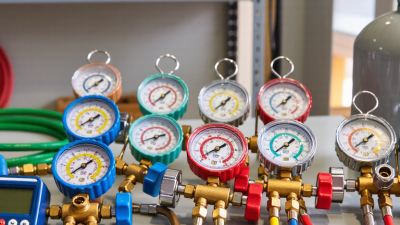
Choosing refrigeration gauges is not a small purchasing decision. A technician may rely on them to check system pressure, compare readings with refrigerant data, and diagnose faults in a hot mechanical room. A sticky manifold valve or unclear display can slow that work. Small details matter.
The U.S. Environmental Protection Agency’s AIM Act schedule reduced permitted HFC production and consumption by 40% below baseline in 2024, with further reductions planned. That shift makes refrigerant compatibility, pressure range, and measurement accuracy important buying considerations. EPA’s phasedown data does not rank gauges, so this guide compares practical features rather than claiming laboratory-tested winners. HVAC educator Bryan Orr’s diagnostic advice is often summarized as, “Measure before you adjust.” Treat that as a useful principle, not a substitute for manufacturer instructions or verified specifications.
This Top 10 guide examines analog and digital options for service technicians, contractors, and HVAC buyers. It considers readable scales, hose and connection quality, refrigerant support, durability, and ease of use. A gauge should fit the work—not just look impressive in a catalog. Expect trade-offs: a compact set may be easier to carry, while a larger display can be simpler to read under poor lighting. The right choice depends on the systems you service and the measurements you need. Check product specifications carefully, and verify compatibility before purchase.
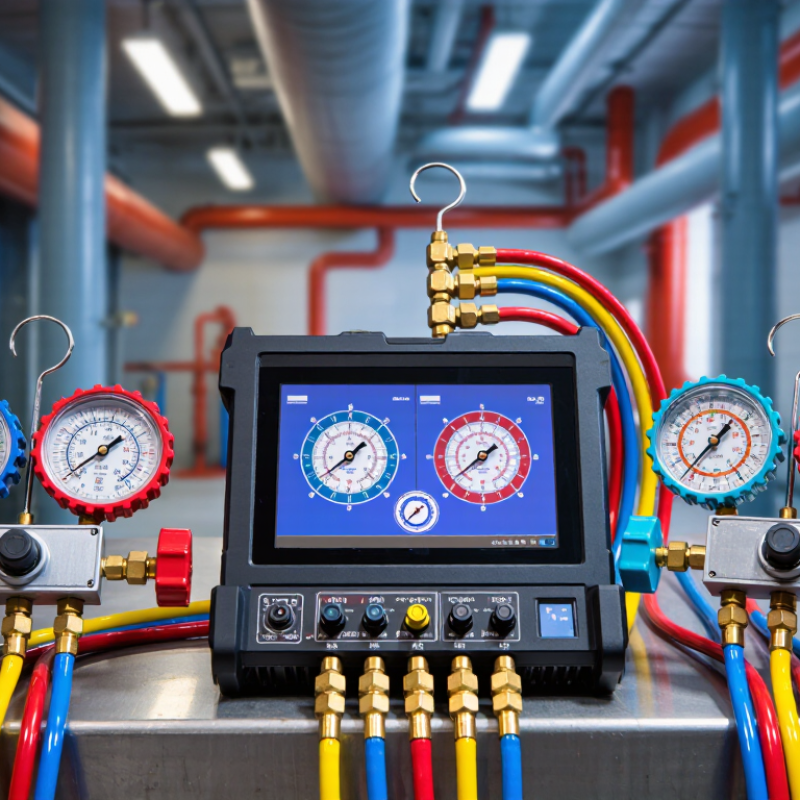
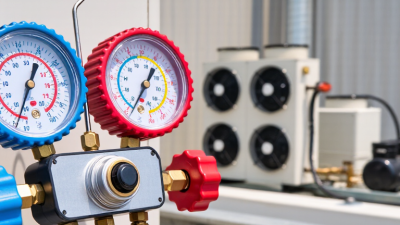
Refrigeration gauges show pressure in an HVAC system, usually on its low- and high-pressure sides. They do not directly measure refrigerant charge, cooling capacity, or temperature. A manifold connects through service ports, while hoses carry system pressure to the gauges. On an analog set, needles move across calibrated scales; digital models display readings electronically. Simple enough.
Pressure matters because refrigerant changes between liquid and vapor as it moves through the system. Many gauges include a pressure-temperature scale for common refrigerants. When you match the measured pressure to the correct refrigerant scale, you can estimate its saturation temperature. The scale must match the refrigerant in the equipment. A mismatch can lead to a confident, wrong interpretation.
For a useful diagnosis, technicians compare pressure with pipe temperature measured using a clamp probe. This helps calculate superheat on the suction line and subcooling on the liquid line. A low-side reading alone cannot explain every fault. Airflow, outdoor conditions, dirty coils, and recent operating changes can affect readings. Even a steady needle may hide a problem if the system has not stabilized. I have found that recording conditions beside each reading makes later comparisons more meaningful.
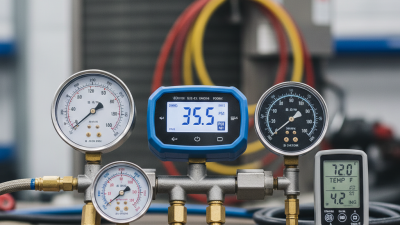
Refrigeration gauges are not one tool with several names. A manifold set combines low- and high-side pressure readings, allowing technicians to compare operating pressures with refrigerant pressure-temperature data. Analog gauges are simple to read at a glance, but parallax and worn pointer mechanisms can affect readings. Digital manifolds display pressure and often calculate saturation temperature. Useful, but the screen cannot correct a poor connection.
Vacuum or micron gauges serve a different task. They measure deep vacuum during evacuation, rather than normal system pressure. A manifold gauge may show that pressure is low while missing whether moisture and non-condensables have been adequately removed. That distinction matters. Place the micron sensor away from the pump when practical, and watch whether the reading stabilizes or rises after isolation.
Refrigerant compatibility also deserves attention. The U.S. EPA’s HFC phasedown schedule targets an 85% reduction in HFC production and consumption by 2036, relative to the statutory baseline. As refrigerants change, buyers should check each gauge’s pressure range, fittings, temperature scale, and supported refrigerant list. A useful gauge set is not automatically a suitable one. Even a correctly rated instrument can mislead when hoses leak, sensors drift, or service ports are restricted. Calibration records and a quick zero check help, though they are easy to overlook on a busy call.
Selecting a refrigeration gauge begins with the system, not the display. Match its pressure range to both suction and discharge pressures; a gauge that runs near its limit can be harder to read accurately. Check refrigerant compatibility, connection type, hose pressure rating, and temperature range. ASHRAE’s Handbook—Fundamentals provides refrigerant pressure-temperature data, useful for checking whether a reading makes sense at the measured line temperature. Small detail, big consequence.
Accuracy deserves a closer look. NIST Technical Note 1297 explains that an expanded uncertainty using coverage factor k=2 corresponds to about 95% coverage under stated statistical assumptions. That’s a metrology reference, not a guarantee that every gauge is accurate to 2%. Read the instrument’s stated accuracy and calibration information, then consider whether the tolerance suits the service task. A few psi may matter when diagnosing a narrow operating range.
For digital gauges, check battery life, backlighting, and whether readings are easy to capture in bright mechanical rooms. For analog models, inspect the scale spacing and pointer stability; crowded markings are frustrating with gloves on. Look for durable seals and replaceable hoses, too. One imperfect habit worth questioning: choosing by maximum pressure alone. A broad range may protect the instrument, but it can make low-side readings less precise. Choose for the pressures you actually expect to measure.
Top 10 Refrigeration Gauges and Their Core Features
A useful gauge set turns pressure readings into practical service decisions. The ten common options are single-pressure analog gauges, dual-manifold analog sets, digital manifolds, low-side gauges, high-side gauges, compound gauges, vacuum gauges, micron gauges, wireless pressure gauges, and differential-pressure gauges. Analog faces are simple and rugged. Digital units often add temperature inputs, pressure-temperature calculations, and logged readings. Vacuum and micron gauges track evacuation; low- and high-side gauges help assess operating pressures. Check each instrument’s range and refrigerant compatibility before use.
The International Energy Agency’s Future of Cooling report states that space cooling used nearly 2,000 TWh of electricity in 2016, about 10% of global electricity use. Accurate measurements matter in equipment that consumes this much energy. Still, a gauge reading alone cannot diagnose a system: airflow, outdoor conditions, load, and sensor placement can change the picture. That detail is easy to miss. A clean, calibrated instrument and stable readings are more useful than a feature-packed meter used carelessly.
Tips: Compare pressure with line temperature, and use the correct pressure-temperature reference for the refrigerant. Keep hoses short and inspect seals for wear. Zero or verify instruments as their manuals specify. One imperfect habit worth reconsidering: treating a single pressure reading as proof of a fault. A second measurement may change the diagnosis.
Typical uses and ranges are general examples, not universal specifications. Always check the instrument’s rated pressure, refrigerant compatibility, accuracy, and operating limits before use.
| No. | Gauge or Instrument Type | Typical Measurement | Core Features | What Buyers Should Check |
|---|---|---|---|---|
| 1 | Low-Side Compound Gauge | Suction pressure and, on compound models, vacuum below atmospheric pressure. Some refrigeration versions cover approximately −30 inHg to 0–250 or 0–500 psi. | Combines a positive-pressure scale with a vacuum scale; commonly used for low-side service checks. | Confirm the pressure range, scale readability, refrigerant temperature markings, and compatibility with the system’s expected pressures. |
| 2 | High-Side Pressure Gauge | Positive pressure on the discharge or liquid side. Ranges vary; some service gauges are rated up to 500 or 800 psi. | Designed to display higher operating pressures than a typical low-side gauge. | Choose a pressure rating with an appropriate margin for the refrigerant and equipment; verify the connection and pressure-pulse rating. |
| 3 | Two-Valve Manifold Gauge Set | Low- and high-side pressures through separate manifold passages. | Two hand valves control access to the low-side, high-side, and center service connections; available with analog gauges. | Check hose and manifold working-pressure ratings, seal materials, connection type, and whether the set suits the refrigerant in use. |
| 4 | Four-Valve Manifold Gauge Set | System pressure readings plus separately controlled service or evacuation paths. | Additional valves can make evacuation, charging, and recovery connections easier to manage without repeatedly changing hoses. | Review the valve layout, port sizes, hose ratings, serviceability, and whether the extra ports fit your workflow. |
| 5 | Digital Refrigerant Manifold | Pressure readings from connected system ports; many models calculate saturation temperature for a selected refrigerant. | Digital display, selectable refrigerant profiles, and often temperature-probe inputs or data logging. | Check supported refrigerants, pressure and temperature accuracy, sensor replacement options, display visibility, and calibration procedures. |
| 6 | Micron Vacuum Gauge | Absolute pressure during evacuation, commonly displayed in microns of mercury (microns Hg). | Measures deep vacuum more precisely than a compound pressure gauge; helps monitor evacuation and vacuum decay. | Look for the measurement range, accuracy, sensor location guidance, contamination resistance, and clear units. It is not a substitute for a pressure gauge. |
| 7 | Pressure–Temperature (P–T) Gauge | Refrigerant pressure, with a corresponding saturation-temperature scale for specified refrigerants. | Helps relate a pressure reading to the refrigerant’s saturation temperature; some dials include multiple refrigerant scales. | Confirm that the dial includes the correct refrigerant and that the temperature scale distinguishes dew-point and bubble-point values where applicable. |
| 8 | Differential Pressure Gauge | Pressure difference between two points, such as across a filter, coil, or component. Ranges are application-specific and may be much lower than system pressure ranges. | Uses two pressure ports to show the difference between inlet and outlet pressure rather than a single point’s pressure. | Match the differential range and maximum static pressure to the application; verify connection type and compatibility with the measured medium. |
| 9 | Compressor Oil Differential Pressure Gauge | Oil pressure relative to crankcase or suction pressure, as required by the compressor design. | Supports checks of compressor lubrication pressure; may be a dedicated gauge or part of an oil safety control. | Use the pressure reference and range specified for the compressor. Confirm whether the application calls for a gauge, a safety control, or both. |
| 10 | Recovery-System Inlet/Outlet Pressure Gauges | Pressure at the recovery equipment’s inlet and outlet connections. | Allows the operator to monitor refrigerant pressure during recovery; gauges may be mounted on the equipment or connected externally. | Check the equipment’s rated pressures, refrigerant compatibility, gauge protection, and manufacturer’s operating instructions. |
Choosing a refrigeration gauge set starts with the work, not the display. For routine pressure checks, a clear analog manifold can be durable and easy to read in a service van. Digital gauges help when a technician needs calculated saturation temperatures or a recorded pressure trend. Either type must suit the refrigerant and pressure range specified for the system. Check the fittings, hose rating, and seals, too. A readable screen means little if a connection leaks.
Small details matter. On a hot rooftop, a backlit display can save time; in a cramped utility closet, compact hoses may be easier to position. For evacuation work, a dedicated micron gauge measures deep vacuum more directly than a manifold pressure gauge. Keep tools task-specific where practical. It can feel excessive. But using one instrument for every measurement may leave gaps, especially when readings seem inconsistent. Gauge accuracy also depends on calibration, clean connections, and careful handling. Compare readings with system conditions rather than treating one number as a diagnosis. A practical kit is the one technicians can maintain, verify, and use correctly under real service conditions.
Match gauge types to common HVAC service tasks using this qualitative task-fit guide.
Scores are a qualitative comparison of how well each gauge type suits common service tasks, not measured product performance. Before buying, confirm refrigerant compatibility, pressure range, accuracy requirements, and applicable safety standards.
3295 Cobb International Blvd.
Kennesaw, GA 30152
800-367-1377
sale@patiostools.com
© 2023 - Marsh Instruments